
Reef stonefish
A highly venomous marine fish known for its rock-like camouflage and potent toxins.
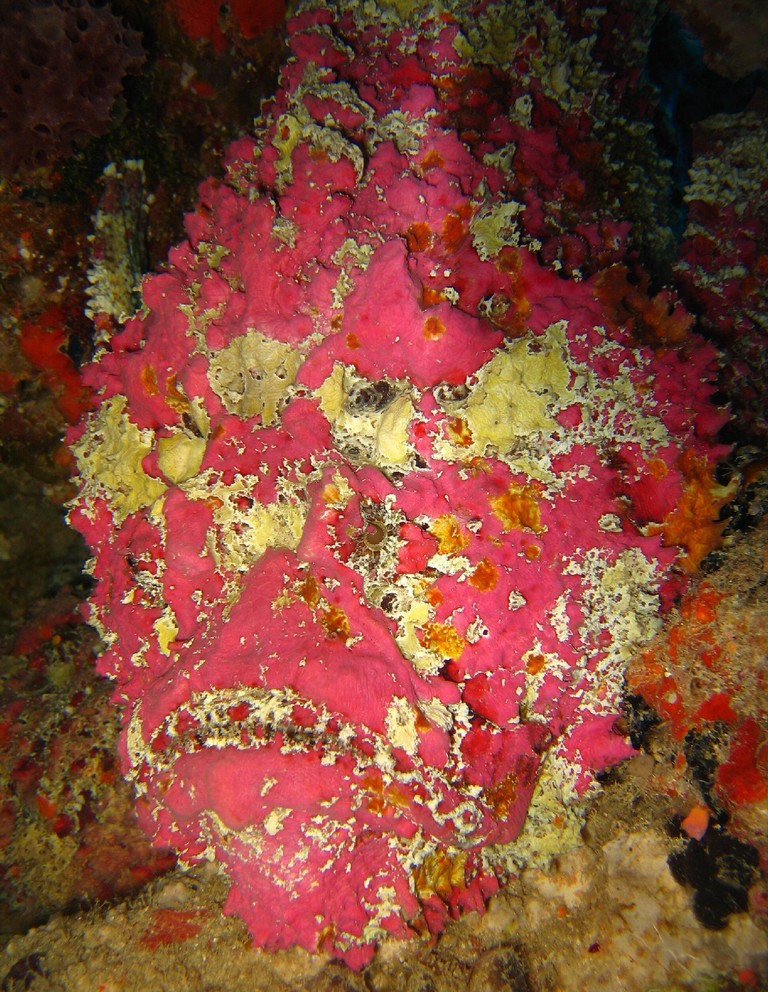
The reef stonefish is a venomous ray-finned fish in the scorpionfish family. It is found across the Indo-Pacific region and is notable for being the most venomous fish species, with a body covered in warts that aids in camouflage among coral reefs.
- Most venomous fish globally; eighteen mg of toxin can kill humans.
- Strikes prey in 0.015 seconds using ambush tactics.
- Skin covered in warts for effective camouflage on reefs.
- Found from Red Sea to French Polynesia; recently in Mediterranean.
- Sold as food in Asia and kept as an aquarium pet.
What it is
This species belongs to the subfamily Synanceiinae within the family Scorpaenidae. Its skin lacks scales but features numerous warts, giving it a rough texture. The colouration varies from brown or grey to patches of yellow, orange, or red. This irregular pattern helps it blend into rocks and corals. It has a wide, flattened head and small eyes directed upward. The dorsal fin holds between twelve and fourteen spines, while the anal fin contains three spines. Pectoral fins are fleshy. Adults typically reach twenty-seven centimetres, though they can grow up to forty centimetres long.
Where it lives
It inhabits shallow tropical waters north of the Tropic of Capricorn. The range extends from the Red Sea and East Africa across the Indian Ocean to the western Pacific, reaching southern Japan and Taiwan. Recent observations indicate presence in the eastern Mediterranean near Israel, Turkey, Lebanon, and Syria, likely via the Suez Canal or aquarium releases. It prefers coral reefs, resting on the seabed or among rocks and plants.
How it lives
It hunts by remaining motionless on the reef floor until prey approaches. It then engulfs small fish, shrimp, and crustaceans at high speed, striking in as little as fifteen milliseconds. This solitary fish aggregates briefly during mating seasons. Females are larger than males. The venomous dorsal spines serve as a primary defence mechanism against predators.
Breeding and life cycle
Females lay unfertilized eggs directly on the reef floor. Males swim over the egg layer to release sperm, resulting in external fertilization. The system is promiscuous, with females accepting sperm from multiple males. Eggs are large, and hatchlings emerge well-developed. Sexual dimorphism is evident, with females attaining greater size than males.
Fish and people
Commercial value lies mainly in the aquarium trade. Meat is sold in Southern China markets and consumed in the Philippines, particularly in Chinese restaurants, and in Japan. The venom is extremely potent, containing proteins like verrucotoxin and stonustoxin. A dose of eighteen milligrams can be fatal to humans. Stings cause severe pain, paralysis, and tissue death. Treatment involves antivenom, hot water immersion to denature proteins, and local anaesthetics. Tourniquets are no longer advised.
Status and threats
It is classified as least concern due to its wide distribution. However, human encounters pose significant risks due to its toxicity. Medical intervention is critical for stings, which can lead to nerve damage or muscle atrophy in survivors. Conservation efforts focus on habitat protection in coral reef ecosystems.


Questions people ask about Reef stonefish
How dangerous is a sting from this fish?
It is the most venomous fish. Eighteen milligrams of toxin can kill humans. Symptoms include severe pain, shock, paralysis, and tissue death. Antivenom and hot water immersion are standard treatments.
Where does the reef stonefish live?
It lives in shallow tropical marine waters of the Indo-Pacific, from the Red Sea to French Polynesia. Recent sightings also occur in the eastern Mediterranean near Israel and Turkey.
What does it eat?
It feeds on small fish, shrimp, and other crustaceans. It waits motionless on the reef floor and engulfs prey rapidly when they swim nearby.
Is it used for food?
Yes. It is sold for meat in Southern China markets and consumed in the Philippines and Japan, often in Chinese restaurants. It is also popular in the aquarium trade.
Good reading and sources
- Synanceia verrucosa on WikipediaEncyclopedia
- More photos on Wikimedia CommonsPhotos
- Wikidata recordOpen data
The facts on this page come from the Wikipedia article "Synanceia verrucosa", written by its contributors and used under the CC BY-SA 4.0 licence, and from its Wikidata record (CC0). EveryFish rewrote the text in its own words, with AI assistance, and compares every page with the article to make sure no passage is copied. It may be reused under the same CC BY-SA 4.0 licence with a link back.
It may contain mistakes, and figures change over time. Nothing here is investment or buying advice. If something is wrong, tell us. Last refreshed 2026-11-15.
Like Reef stonefish
All other fish WorldBlue-spotted grouper
A widely distributed Indo-Pacific grouper known for its blue spots and invasive impact in Hawaii.Other · Coasts and shelves
 WorldBigeye trevally
A large marine fish found in tropical oceans, known for its nocturnal hunting and distinctive dark dorsal fin.Other · Coasts and shelves · 1825
 WorldAnglerfish
Ray-finned fish using a modified dorsal fin ray as a lure to catch prey.Other · Coasts and shelves · 1829
 WorldQueen triggerfish
Large, colourful reef fish of the tropical Atlantic.Other · Coasts and shelves · 1758
More from Scorpaenidae
All of them WorldLeaf scorpionfish
A small reef fish that mimics a drifting leaf to ambush prey.Other · Coral reefs · 1802
 WorldDevil firefish
Venomous Indo-Pacific reef fish with feathery finsOther · Coasts and shelves · 1828
 🇮🇩 Indonesia and 4 moreEstuarine stonefish
A venomous marine ray-finned fish found in the Indo-Pacific region.Shark · Coasts and shelves · 1766
 🇮🇩 Indonesia and 2 moreRed lionfish
Venomous coral reef fish native to the Indo-Pacific and invasive in the Atlantic.Reef fish · Coral reefs · 1758