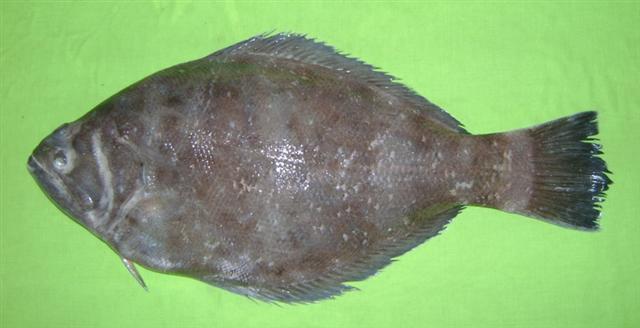
Indian halibut
A primitive flatfish with spiny dorsal rays and night habits.
The Indian halibut is a bottom-dwelling flatfish native to warm waters from the Red Sea to Australia. It grows up to 64 cm and serves as a key food source in Thailand, where traditional night fishing methods persist.
- Largest member of the Psettodidae family
- Has spiny rays before the dorsal fin
- Hunts small fish on sandy bottoms at night
- Traditional Thai catch method uses lanterns and harpoons
- Eye sits at the edge of the head
What it is
This species belongs to the flatfish group but retains primitive traits. Its body is thicker and less flattened than modern relatives. One eye migrates to the head edge rather than sitting fully on top. Distinctive spiny rays appear before the dorsal fin. Multiple pale stripes run along its upper side. It is the largest member of its family, reaching lengths of 64 cm.
Where it lives
These fish inhabit the Indian and Pacific Oceans. Their distribution stretches from the Red Sea down to northern Australia. They prefer sandy or muddy seabeds. Individuals live at depths between one metre and one hundred metres. This range covers warm coastal waters across a vast geographic area.
How it lives
Feeding occurs at night on the ocean floor. The diet consists of small fish and other aquatic creatures. During the day, they often bury themselves in sand. This behaviour helps them avoid detection. They remain hidden until darkness falls, then hunt for prey on the soft bottom substrate.
Fish and people
In Thailand, this fish holds economic value. Fishermen traditionally use storm lanterns to spot them buried in sand at night. Once located, they are caught with harpoons. Local names include 'one-eyed fish' and 'jackfruit leaf fish'. Cooks serve it deep-fried with spicy sour sauce. Dried versions flavour noodle soups with pandan leaves in Teochew recipes.
Questions people ask about Indian halibut
How big does the Indian halibut grow?
Adults typically measure between 18 cm and 50 cm. The maximum recorded length is 64 cm. The heaviest specimen weighed 9 kg. This makes it the largest species within its family.
What makes this flatfish primitive?
It has a thicker body that is less compressed than other flatfish. The migrated eye sits at the edge of the head instead of moving fully to the top. These traits distinguish it from more evolved flounder species.
How is it caught in Thailand?
Fishermen shine storm lanterns on sandy shores at night. The light reveals fish buried under the sand. They then spear the visible targets with harpoons. This traditional method relies on spotting the fish while they rest.
Good reading and sources
- Psettodes erumei on WikipediaEncyclopedia
- More photos on Wikimedia CommonsPhotos
- Wikidata recordOpen data
The facts on this page come from the Wikipedia article "Psettodes erumei", written by its contributors and used under the CC BY-SA 4.0 licence, and from its Wikidata record (CC0). EveryFish rewrote the text in its own words, with AI assistance, and compares every page with the article to make sure no passage is copied. It may be reused under the same CC BY-SA 4.0 licence with a link back.
It may contain mistakes, and figures change over time. Nothing here is investment or buying advice. If something is wrong, tell us. Last refreshed 2026-11-15.
Like Indian halibut
All flatfish 🇺🇸 United States and 1 moreSummer flounder
A predatory flatfish of the US Atlantic coast.Flatfish · Coasts and shelves
 🇨🇦 Canada and 4 moreAtlantic halibut
The world's largest flatfish, found in the North Atlantic.Flatfish · Coasts and shelves
 EuropeEuropean flounder
A right-eyed flatfish found in European coastal waters and rivers.Flatfish · Rivers and lakes