
Pelican eel
A deep-sea eel with a massive hinged jaw and ultra-black skin found in all oceans.
The pelican eel is a rare deep-sea fish known for its enormous mouth and dark camouflage. It lives in the bathypelagic zone of all major oceans and feeds on small prey using lunge-feeding techniques.
- Mouth can be a quarter of total body length.
- Skin reflects less than 0.5% of light.
- Found in all oceans at depths up to 3,000m.
- Males enlarge olfactory organs to find mates.
- Larvae feed on marine snow and organic debris.
What it is
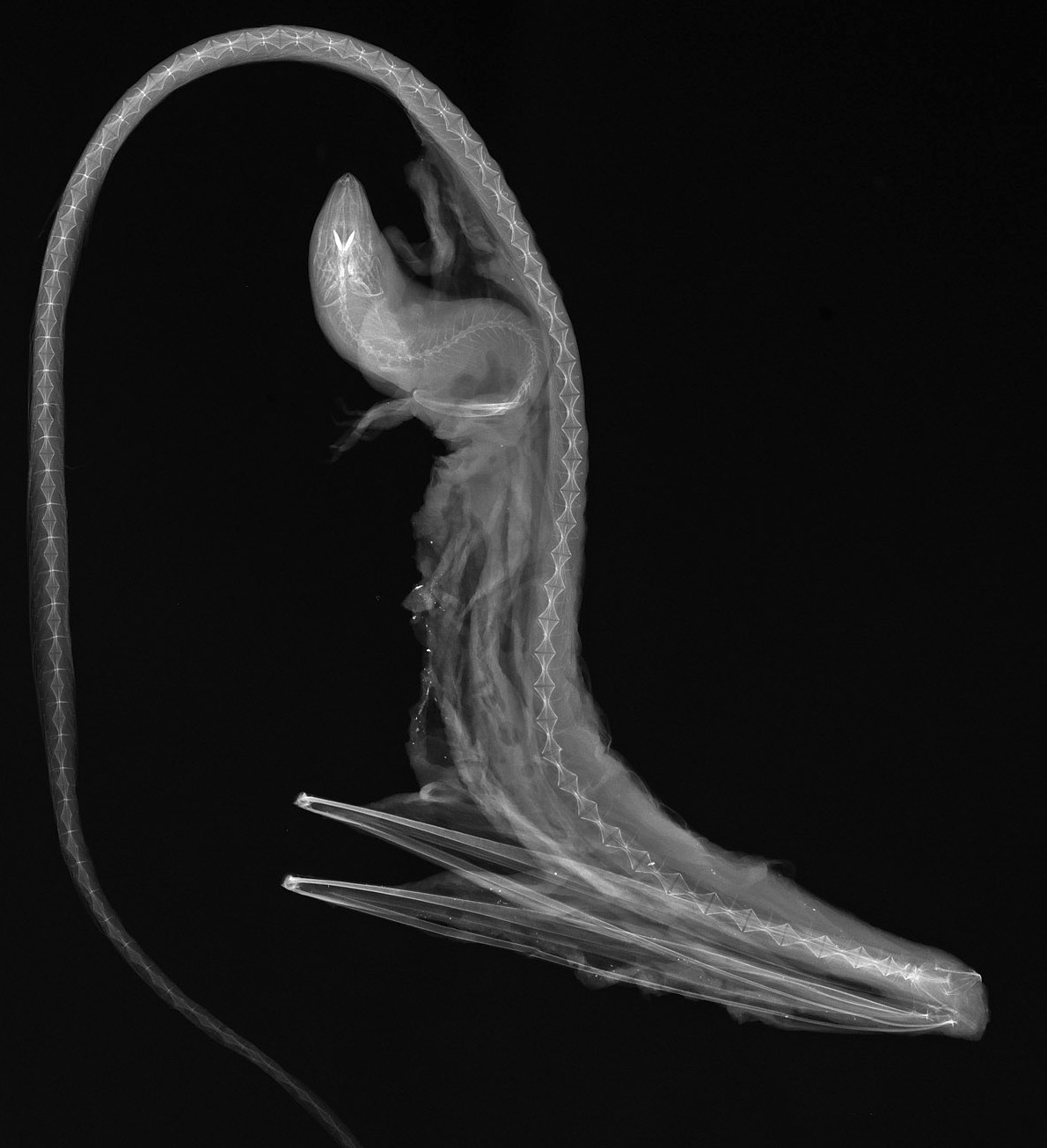
This species belongs to the order Anguilliformes and is the sole member of its family. It possesses a disproportionately large mouth that can open wider than its body width. The head structure lacks mass behind the lower jaw, allowing it to unfold and inflate during hunting. Adults reach lengths of up to one metre. Their skin reflects less than half a percent of light, creating an ultra-black appearance that hides them in low-light environments. They lack scales and pelvic fins, features common to other eels.
Where it lives
Specimens have been recorded in temperate and tropical waters across all global oceans. In the North Atlantic, they inhabit depths between five hundred and three thousand metres. Records include finds near Greenland, Portugal, and Hawaii. A specimen was also captured in the Davis Strait at significant depth. These animals do not perform vertical daily migrations like many other eel species.
How it lives
They hunt by actively pursuing prey rather than waiting passively. The eel uses a lunge-feeding method, expanding its jaws to scoop up food. Despite the jaw size, teeth are tiny, suggesting a diet of small crustaceans and squid. Water ingested during feeding is expelled through gills. They face predation from lancetfish. Males develop enlarged sense-of-smell organs to detect mates via pheromones in the dark water column.
Breeding and life cycle
Young start as transparent leptocephalus larvae that feed on marine snow and organic particles. As they mature, their teeth change shape and number. Adult males undergo physical changes including stomach shrinkage to accommodate reproductive organs and nasal rosette enlargement. Females show fewer morphological changes. Researchers suspect adults die shortly after reproducing, a strategy potentially improving offspring survival rates.
Fish and people
Knowledge of this species comes largely from accidental catches in deep-sea fishing nets since 1970. Direct observation is rare but has occurred near Azores and Papahānaumokuākea Marine National Monument. Scientists study these specimens to understand deep-sea biology. There is no commercial use or cultural significance recorded. Research focuses on their unique biological adaptations and phylogenetic relationships.
Status and threats
Data is insufficient to assess conservation status accurately. Most information derives from incidental captures rather than systematic surveys. Threats are unknown due to limited access to their deep-water habitat. Conservation efforts are minimal because the species is rarely encountered. Further research is needed to determine population trends and specific environmental risks.



Questions people ask about Pelican eel
What does the pelican eel eat?
Adults primarily consume small crustaceans and squid. They use lunge-feeding to scoop prey. Larvae feed on marine snow and organic particles found in the deep ocean water column.
How big does a pelican eel get?
They typically grow to about 0.75 metres. Some plausible specimens may reach one metre in length. Their mouth alone can occupy a quarter of their total body length.
Where do pelican eels live?
They inhabit deep waters in temperate and tropical zones of all oceans. Depths range from 500 to 3,000 metres. They are found near places like Greenland, Portugal, and Hawaii.
Why is the pelican eel black?
Their skin exhibits ultra-black camouflage, reflecting less than 0.5% of light. This helps them hide from predators and ambush prey in the dark deep-sea environment.
Good reading and sources
The facts on this page come from the Wikipedia article "Pelican eel", written by its contributors and used under the CC BY-SA 4.0 licence, and from its Wikidata record (CC0). EveryFish rewrote the text in its own words, with AI assistance, and compares every page with the article to make sure no passage is copied. It may be reused under the same CC BY-SA 4.0 licence with a link back.
It may contain mistakes, and figures change over time. Nothing here is investment or buying advice. If something is wrong, tell us. Last refreshed 2026-11-15.
Like Pelican eel
All eels WorldHagfish
Eel-shaped jawless marine animals known for producing vast amounts of slime.Eel · Open ocean
 WorldSlender snipe eel
A deep-sea eel with a bird-like beak and extreme length.Eel · Open ocean
 🇧🇷 Brazil and 1 moreElectric eel
Neotropical freshwater fish capable of generating powerful electric shocks for hunting and defence.Eel · Rivers and lakes · 1766
 🇨🇳 China and 3 moreAsian swamp eel
A freshwater, air-breathing fish native to Asia and introduced elsewhere.Eel · Rivers and lakes