
Orange clownfish
Bright orange reef fish with three white bars
The orange clownfish is a small, vibrant marine species known for its symbiotic bond with sea anemones. It lives in warm Pacific and Indian Ocean reefs, where it relies on host anemones for protection while providing cleaning services in return.
- Grows to 11 cm with three white bars
- Born male, changes to female if needed
- Lives in symbiosis with sea anemones
- Male guards and fans eggs until hatching
- Can shrink body size during heatwaves
What it is
This small reef fish reaches a maximum length of 11 cm, though adults average 8 cm. Its body is bright orange with three distinct white vertical bars outlined in black. The first bar sits behind the eye, the second runs down the middle with a forward bulge, and the third is near the tail. Black edges trim each fin. Males and females share identical colouring. It is often confused with the ocellaris clownfish, but can be distinguished by having ten dorsal spines rather than eleven, and thicker black fin margins.
Where it lives
Populations inhabit warm waters across the Pacific and Indian Oceans. Specific regions include northwest Australia, southeast Asia, and Japan. They reside in shallow coastal reefs where depths rarely exceed 12 metres. Water temperatures in these habitats typically range between 25 and 28 degrees Celsius. The fish depend on specific sea anemones for shelter, preferring Heteractis magnifica and Stichodactyla gigantea. They avoid very shallow zones due to low salinity and temperature fluctuations during low tides.
How it lives
Individuals live in strict size-based hierarchies within a single host anemone. The largest fish is the breeding female, followed by the breeding male, then smaller non-breeders. Aggression among males suppresses growth, keeping subordinates small. They feed on algae, zooplankton, worms, and tiny crustaceans. The relationship with the anemone is mutualistic. The fish gain protection from predators like wrasses and brittle stars. In return, they clean the anemone, remove waste, and improve oxygenation through movement.
Breeding and life cycle
These fish are protandrous hermaphrodites, meaning all are born male. If the dominant female dies, the breeding male changes sex to become female, and the largest subordinate becomes the breeding male. Spawning occurs year-round in warm latitudes, often linked to the lunar cycle. The female lays 400 to 1500 eggs on a cleaned rock surface near the anemone. The male fertilises them and guards the nest, fanning the eggs for oxygen. Hatching takes six to eight days, usually after sunset on dark nights.
Fish and people
This species is highly popular in the aquarium trade. Keeping them in captivity requires careful management due to their specific needs. The Great Barrier Reef Marine Park Authority regulates collection permits to control harvesting from wild populations. Their striking appearance and unique behaviour make them a favourite among hobbyists. In home tanks, they tend to be peaceful compared to their competitive nature in the wild. They do not serve as food fish or have significant cultural roles beyond the ornamental market.
Status and threats
Marine heatwaves pose a threat, causing some individuals to shrink their bodies to survive stress. Survival chances during these events relate to social rank and size. Ocean acidification was once thought to impair larval ability to smell predators and find reefs. However, recent studies suggest these behavioural effects may be negligible or not reproducible. Recruitment depends on the availability of suitable anemones and low predator pressure during the larval phase.


Questions people ask about Orange clownfish
How can you tell it apart from similar clownfish?
Count the spines on the first dorsal fin. This species has ten spines, whereas the similar ocellaris clownfish has eleven. Also, look for thick black edging on the fins, which is absent in the ocellaris variety.
Why do they live inside sea anemones?
The anemone provides protection from predators using its stinging tentacles. The fish is immune to the sting. In return, the fish cleans the anemone, removes waste, and drives away polyp-eating pests, creating a mutually beneficial relationship.
Do they change gender?
Yes. All individuals are born male. They live in groups where the largest is female. If she dies, the breeding male transforms into a female, and the next largest male becomes the breeder. This is called protandry.
What do orange clownfish eat?
They consume algae, zooplankton, small worms, and tiny crustaceans. They also help feed their host anemone by carrying food pieces to it, which the anemone later consumes.
Good reading and sources
- Orange clownfish on WikipediaEncyclopedia
- More photos on Wikimedia CommonsPhotos
- Wikidata recordOpen data
The facts on this page come from the Wikipedia article "Orange clownfish", written by its contributors and used under the CC BY-SA 4.0 licence, and from its Wikidata record (CC0). EveryFish rewrote the text in its own words, with AI assistance, and compares every page with the article to make sure no passage is copied. It may be reused under the same CC BY-SA 4.0 licence with a link back.
It may contain mistakes, and figures change over time. Nothing here is investment or buying advice. If something is wrong, tell us. Last refreshed 2026-11-15.
Like Orange clownfish
All reef fish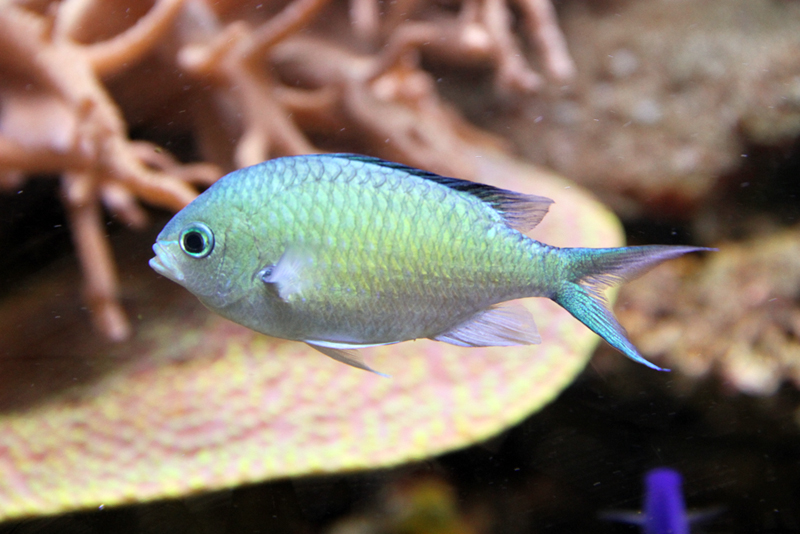 WorldGreen chromis
Small iridescent reef damselfish found across the Indo-Pacific.Reef fish · Coral reefs
 WorldRegal blue tang
Bright blue reef fish with a yellow tail and black markings.Reef fish · Coral reefs
 East AsiaTomato clownfish
A bright orange-red marine fish from the Western Pacific.Reef fish · Coasts and shelves
 WorldBluespotted cornetfish
Long, slender reef fish with a tubular snout and blue spots.Reef fish · Coasts and shelves