
Ocellate river stingray
A widespread freshwater stingray from South America known for its spotted disc and popularity in large aquaria.
The ocellate river stingray is a species of freshwater ray found across major South American basins. It was the first member of its family described and remains the most common, often kept in captivity due to its distinctive appearance.
- First species described in the family Potamotrygonidae.
- Grows up to one metre in total length and thirty-four kilograms.
- Found in the Amazon, Orinoco, Mearim and Río de la Plata basins.
- Breeds live young in captivity, popular among aquarium hobbyists.
- Taxonomy is complex with several recently separated species.
What it is
This freshwater ray features a roughly circular disc that can reach fifty centimetres across. Its skin displays beige or brown tones covered with yellow-orange spots framed by dark rings. The eyes sit raised above the surface, and individuals vary significantly in colour and spot arrangement depending on their location. Some populations show chain-like patterns near the rim, while others appear marbled.
Where it lives
The species inhabits tropical and subtropical waters throughout South America. Its range covers the Amazon, Río de la Plata, Mearim and Orinoco basins. It is absent from the Paraná Basin upstream of the Itaipu Dam. Populations exist in Peru, Brazil and adjacent regions connected by waterways like the Casiquiare canal.
How it lives
Morphology varies widely across its extensive range, prompting taxonomic reviews. Distinct types co-occur in the Amazon, though some have been reclassified as separate species like P. marquesi. The ray breeds readily in captivity, giving birth to live young.
Breeding and life cycle
Ocellate river stingrays reproduce by giving birth to live pups rather than laying eggs. They breed successfully in captive environments, making them suitable for aquarium keeping despite the need for substantial tank space.
Fish and people
Aquarists sometimes keep this species due to its popularity and distinctive markings. Keeping them requires very large tanks similar to other members of the Potamotrygon genus. No traditional food uses or cultural roles are mentioned in the available information.
Status and threats
The species is considered widespread and was the first described in its family. Taxonomic complexity exists within the group, with several related forms identified in different basins.


Questions people ask about Ocellate river stingray
What does the ocellate river stingray look like?
It has a circular disc up to fifty centimetres wide with beige or brown skin. The body is covered in yellow-orange spots with dark rings. Eye placement is raised, and spot patterns vary by region.
Where does this stingray live?
It inhabits freshwater systems in South America. Key ranges include the Amazon, Orinoco, Mearim and Río de la Plata basins. It is absent from parts of the Paraná Basin.
Is it kept in aquariums?
Yes, it is popular in the aquarium trade. However, it requires very large tanks. It breeds readily in captivity by giving birth to live pups.
Good reading and sources
- Ocellate river stingray on WikipediaEncyclopedia
- More photos on Wikimedia CommonsPhotos
- Wikidata recordOpen data
The facts on this page come from the Wikipedia article "Ocellate river stingray", written by its contributors and used under the CC BY-SA 4.0 licence, and from its Wikidata record (CC0). EveryFish rewrote the text in its own words, with AI assistance, and compares every page with the article to make sure no passage is copied. It may be reused under the same CC BY-SA 4.0 licence with a link back.
It may contain mistakes, and figures change over time. Nothing here is investment or buying advice. If something is wrong, tell us. Last refreshed 2026-11-15.
Like Ocellate river stingray
All rays and skates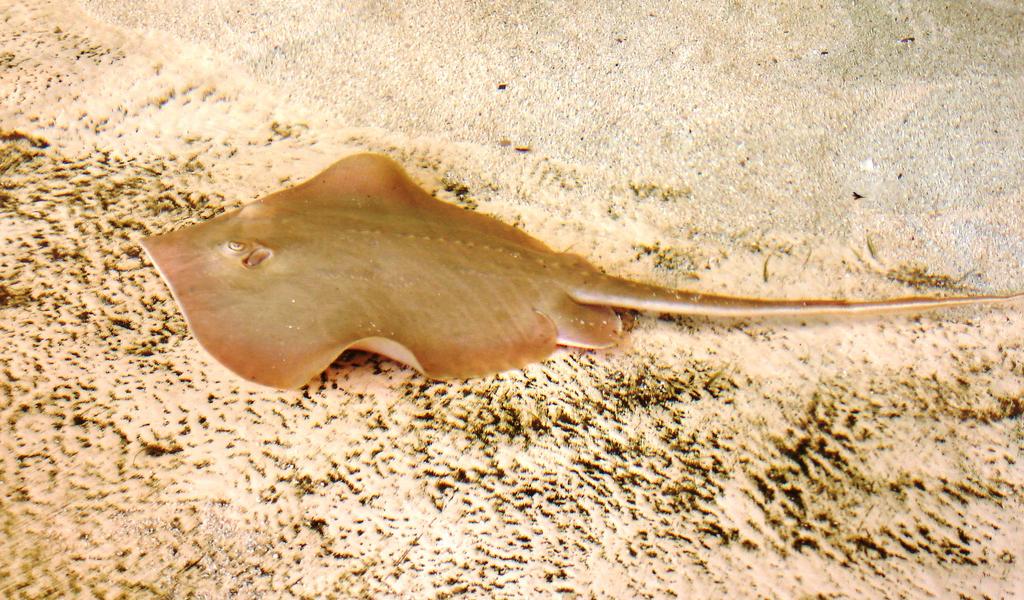 🇺🇸 United States and 1 moreAtlantic stingray
Small stingray found in Atlantic coastal waters and fresh rivers.Ray · Rivers and lakes · 1824
 🇺🇸 United States and 2 moreRound stingray
A small coastal ray from the eastern Pacific known for its painful tail spine.Ray · Coasts and shelves
 🇦🇺 AustraliaDwarf sawfish
Smallest sawfish species, native to tropical Australia and New Guinea.Ray · Estuaries and mangroves
 🇺🇸 United States and 1 moreBat ray
A large eagle ray with wing-like fins found in the eastern Pacific.Ray · Coasts and shelves