
Mullet
A worldwide family of coastal ray-finned fish known for their distinct dorsal fins and historical culinary value.
The mullets are a family of ray-finned fish found in temperate and tropical waters globally. They have provided food in Mediterranean Europe since Roman times and were historically consumed in ancient Egypt.
- Family contains about 78 species in 26 genera.
- Distinguished by two separate dorsal fins and no lateral line.
- Ancient Egyptians ate pickled and dried mullet called fesikh.
- Leaping behaviour may help gain oxygen via a throat organ.
- 1960s Florida campaign renamed mullet to lisa to boost sales.
What it is
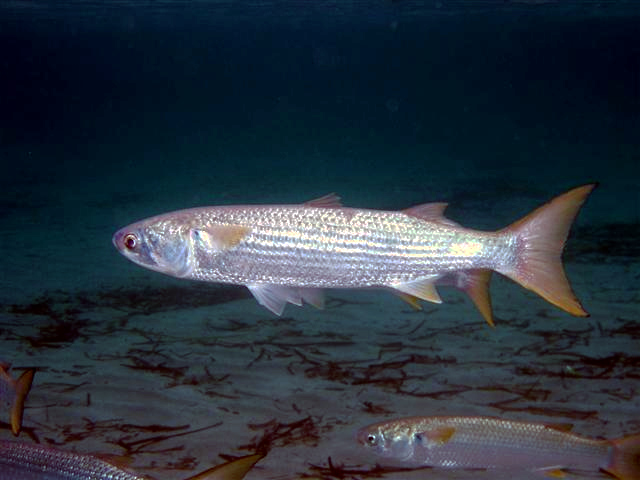
Mullets belong to the family Mugilidae, comprising roughly seventy-eight species across twenty-six genera. These ray-finned fish possess two separate dorsal fins and small triangular mouths. They lack a lateral line organ, which is a sensory structure found in many other fish. The oldest known fossil dates to the Oligocene epoch in France. Taxonomically, they form the order Mugiliformes and share ancestry with Asiatic glassfishes. In North America, the term usually refers to this family, whereas European usage often distinguishes them from red mullets or goatfish.
Where it lives
These fish inhabit coastal waters across the globe in both temperate and tropical zones. Certain species also thrive in freshwater environments. Their distribution spans major oceans and connected river systems where salinity levels vary. Historical records indicate their presence in Mediterranean Europe and ancient Egyptian waters. Indigenous communities in Florida, Hawaii, and North Carolina utilized these fish long before modern commercial fishing began.
How it lives
Mullets feed primarily on detritus, requiring muscular stomachs and complex pharyngeal structures for digestion. A notable behaviour involves leaping from the water. One type is a clean escape jump from predators. Another is a slower side-turning leap that creates a large splash. Scientists believe the latter helps the fish access oxygen-rich air through a specialized organ above the throat. Larval development has been studied extensively, particularly for widespread species used in aquaculture.
Breeding and life cycle
Information regarding specific spawning habits, egg types, and juvenile growth rates is not detailed in the provided sources. Research focuses more on larval osteological development and identifying malformations in farmed specimens rather than natural breeding cycles.
Fish and people
Mullets have served as an important food source in Mediterranean Europe since Roman times. In ancient Egypt, people consumed pickled and dried mullet known as fesikh. Early American commercial fishers in the nineteenth century dismissed the catch as low-value trash fish. This led to a decline in popularity until a 1960s marketing campaign attempted to revive interest by renaming the fish lisa.
Status and threats
Historical shifts in market value influenced consumption patterns but do not reflect modern ecological standing.



Questions people ask about Mullet
What defines a mullet biologically?
Mullets are ray-finned fish in the family Mugilidae. They feature two separate dorsal fins, small triangular mouths, and lack a lateral line organ. They digest detritus using muscular stomachs and complex pharyngeal structures.
Where can you find mullets?
They are found worldwide in coastal temperate and tropical waters. Some species also live in freshwater habitats. Historical records show their use in Mediterranean Europe and ancient Egypt.
Why do mullets jump out of the water?
They perform two types of leaps. One escapes predators. The other is a slower turn creating a splash. Scientists think this helps them access oxygen-rich air through a special organ above the pharynx.
Good reading and sources
- Mullet (fish) on WikipediaEncyclopedia
- More photos on Wikimedia CommonsPhotos
- Wikidata recordOpen data
The facts on this page come from the Wikipedia article "Mullet (fish)", written by its contributors and used under the CC BY-SA 4.0 licence, and from its Wikidata record (CC0). EveryFish rewrote the text in its own words, with AI assistance, and compares every page with the article to make sure no passage is copied. It may be reused under the same CC BY-SA 4.0 licence with a link back.
It may contain mistakes, and figures change over time. Nothing here is investment or buying advice. If something is wrong, tell us. Last refreshed 2026-11-15.
Like Mullet
All other fish 🇺🇸 United States and 1 moreEulachon
A small anadromous smelt known for its high fat content and cultural importance in Pacific North America.Other · Rivers and lakes
 🇹🇷 Turkey and 4 moreAnchovy
Small, oily forage fish found in oceans and some rivers worldwide.Herring · Coasts and shelves
 🇦🇷 Argentina and 4 moreArgentinian silverside
A large, adaptable silverside native to South America.Other · Rivers and lakes
 🇩🇪 Germany and 4 moreEuropean smelt
Small coastal fish with a cucumber scentOther · Rivers and lakes