
Manta ray
Large filter-feeding rays in the genus Mobula
Manta rays are three species of large rays now placed in the genus Mobula after being in their own genus. They live in warm ocean waters where they filter feed on plankton and face threats from fishing and pollution that have led to a vulnerable status.
- Largest species reaches seven metres across
- Diet mostly from deeper water sources
- Vulnerable due to gill plate trade
- Show signs of self awareness in tests
- Visit cleaning stations on reefs
What it is
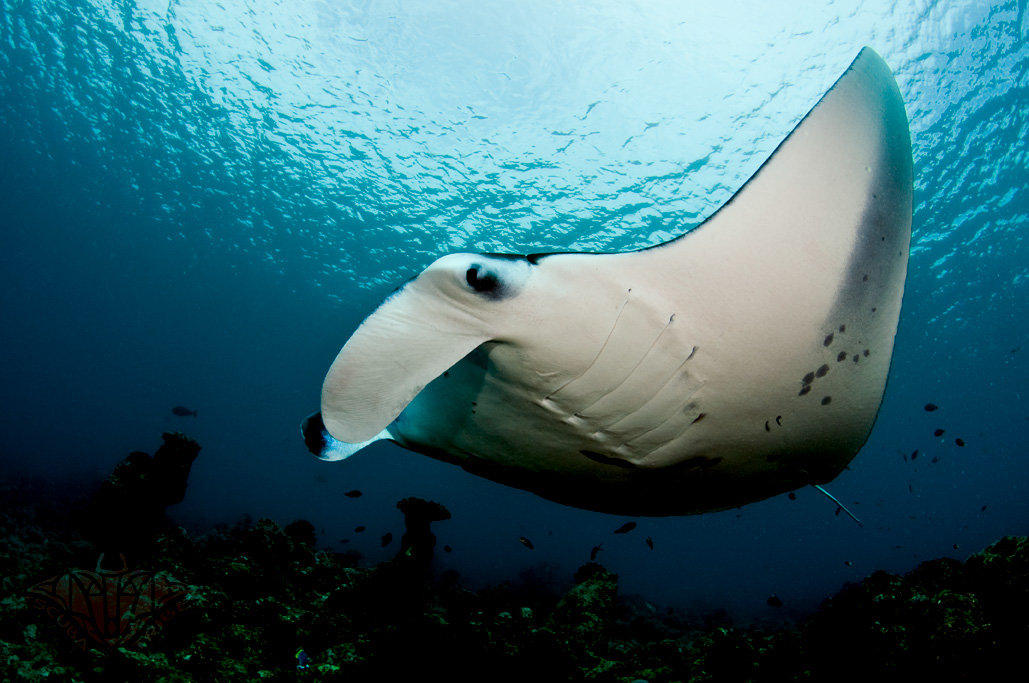
Manta rays have broad heads and triangular side fins that they use to swim like wings. Horn shaped fins sit beside their large forward facing mouths. Bodies are flattened with eyes on the head sides and gill openings underneath. Tails are short and unsupported by skeleton. Skin colour is usually dark on top with pale areas below that vary between individuals. Three species exist with the largest reaching seven metres in width. They inhabit warm ocean regions. They belong to the eagle ray family and were once in a separate genus.
Where it lives
Manta rays live in warm temperate subtropical and tropical waters. Some species cross open oceans while others stay near coasts. They swim in deep water or shallow areas. Depths reached include over four hundred metres. The largest species migrates across oceans singly or in groups. The smallest tends to remain in one coastal area.
How it lives
These rays eat by filtering small animals from the water as they swim. Their diet includes zooplankton and some fish from deeper layers. They move alone or in groups of up to fifty. Sometimes they leap from the water. They visit reefs to have parasites cleaned off by small fish. Large predators like sharks and orcas may attack them. Their brains are large relative to body size.
Breeding and life cycle
Mating occurs at different seasons in various regions. Males chase females in lines. Courtship involves the male grasping the female fin and turning over. After pairing the female carries the developing young for more than twelve months. She then gives birth to live pups.
Fish and people
Fishers target these rays for their gill plates which are used in traditional Chinese medicine. They also get caught in nets and suffer from pollution. Their slow rate of reproduction makes populations slow to recover. International rules protect them in open waters but they remain at risk near land. Tourists often watch them at popular spots. Only a small number of aquariums have tanks big enough for them.
Status and threats
These rays are considered vulnerable to extinction. Main dangers come from people through harvesting pollution and accidental capture. Their low birth rate worsens the problem. They receive protection under agreements for migratory animals but enforcement is weaker close to shores. Areas where they gather attract visitors but also increase risks.


Questions people ask about Manta ray
What do manta rays eat?
Manta rays filter feed on zooplankton such as shrimp and krill near the surface. They also consume small to medium sized fish from deeper parts of the ocean. Most of their food comes from mesopelagic zones rather than the surface.
How do manta rays reproduce?
Mating takes place in trains where males follow a female. The male grasps her fin and mates for up to ninety seconds. The female then carries the young for over a year before giving birth to live pups.
Where are manta rays found?
They live in warm temperate subtropical and tropical waters worldwide. Some species migrate across open oceans while others stay in coastal areas. They can dive to depths of more than four hundred metres.
Why are manta rays vulnerable?
They are harvested for gill plates used in medicine and get entangled in nets. Pollution adds to the threats. Their slow reproduction rate means populations recover slowly from losses.
Good reading and sources
The facts on this page come from the Wikipedia article "Manta ray", written by its contributors and used under the CC BY-SA 4.0 licence, and from its Wikidata record (CC0). EveryFish rewrote the text in its own words, with AI assistance, and compares every page with the article to make sure no passage is copied. It may be reused under the same CC BY-SA 4.0 licence with a link back.
It may contain mistakes, and figures change over time. Nothing here is investment or buying advice. If something is wrong, tell us. Last refreshed 2026-11-15.
Like Manta ray
All rays and skates WorldGiant oceanic manta ray
The world's largest ray, a massive filter-feeding predator of tropical oceans.Ray · Coasts and shelves · 1827
 🇺🇸 United States and 1 moreCownose ray
A migratory coastal ray with a distinctive head shape.Ray · Coasts and shelves
 WorldSpotted eagle ray
Tropical ray with white spots and a long tail.Ray · Coasts and shelves · 1790
 🇬🇧 United Kingdom and 4 moreMarbled electric ray
A benthic electric ray from the eastern Atlantic known for its powerful shocks and mottled brown skin.Ray · Coasts and shelves · 1810