
King mackerel
A large, fast-swimming predatory fish of the western Atlantic and Gulf of Mexico.
The king mackerel is a migratory species found in the western Atlantic Ocean and the Gulf of Mexico. It is highly valued by both commercial fisheries and recreational anglers for its speed and taste.
- Migrates between North Carolina and Brazil following warm waters.
- Can exceed 40 kg in weight and reach speeds rivaling wahoo.
- High mercury levels make it unsafe for pregnant women and children.
- Young fish have yellowish-brown spots that fade as they grow.
- Spawns in the open sea, releasing millions of eggs per female.
What it is
This medium-sized fish features an olive back that fades to silver sides with a rosy sheen, and a white belly. Its body is covered in tiny, loose scales. The lateral line dips sharply at the middle before running horizontally to the tail. Young fish display yellowish-brown spots on their flanks, which disappear as they grow larger than five kilograms. They possess large, flattened teeth similar to those of the bluefish. The first dorsal fin is colorless and folds into a groove along the back.
Where it lives
King mackerel inhabit subtropical waters of the western Atlantic, ranging from North Carolina down to Rio de Janeiro in Brazil. They occasionally appear as far north as the Gulf of Maine. These fish prefer water temperatures between twenty and twenty-nine degrees Celsius. While primarily coastal, they can be found at depths of up to forty-five meters, though larger individuals may venture deeper near the Gulf Stream or closer to shore in harbors.
How it lives
These voracious carnivores migrate seasonally, moving north in summer and south in winter to follow warmer waters and prey. They travel in large schools and feed on squid, sardines, jacks, and cutlassfish. Despite being aggressive hunters, they do not attack humans but may bite if threatened during man-overboard situations. Their high speed makes them formidable gamefish, comparable to wahoo in their blistering runs when hooked.
Breeding and life cycle
Reproduction occurs via external fertilization in the open sea. Females release between fifty thousand and several million eggs depending on their size. Fertilized eggs hatch within approximately twenty-four hours. The resulting larvae are tiny, measuring about two and a half millimeters with a large yolk sac. Little is known about their early life stages, but yearlings typically weigh around one and a half kilograms.
Fish and people
King mackerel are prized targets for sport fishing tournaments and commercial harvests. Anglers use trolling techniques with live bait, spoons, or jigs. Commercially, they are caught using gill nets or trolling gear. As food, they are marketed fresh, often grilled, fried, or smoked. However, health authorities advise that children and pregnant women avoid consuming them due to high methylmercury levels, which pose a risk of poisoning.
Status and threats
The species is currently listed as least concern by conservation groups. No specific threats like overfishing or habitat loss are detailed in the provided text regarding its population status. Management focuses on regulating the significant commercial and recreational fishing industries that target this popular species throughout its range.

Questions people ask about King mackerel
How can I tell a king mackerel apart from an Atlantic Spanish mackerel?
Look at the lateral line. On a king mackerel, it dips abruptly at the mid-body. On an Atlantic Spanish mackerel, it slopes gradually from the gill to the tail. Also, kings lack the black patch on the first dorsal fin found in Spanish mackerel.
Is king mackerel safe to eat?
It is a popular food fish prepared by grilling or smoking. However, the US FDA advises that children and pregnant women should avoid it due to high methylmercury levels, which can cause poisoning.
Where does the king mackerel live?
It inhabits the western Atlantic Ocean and the Gulf of Mexico. Its range extends from North Carolina to Brazil, preferring coastal waters with temperatures between 20 and 29 degrees Celsius.
Good reading and sources
- King mackerel on WikipediaEncyclopedia
- More photos on Wikimedia CommonsPhotos
- Wikidata recordOpen data
The facts on this page come from the Wikipedia article "King mackerel", written by its contributors and used under the CC BY-SA 4.0 licence, and from its Wikidata record (CC0). EveryFish rewrote the text in its own words, with AI assistance, and compares every page with the article to make sure no passage is copied. It may be reused under the same CC BY-SA 4.0 licence with a link back.
It may contain mistakes, and figures change over time. Nothing here is investment or buying advice. If something is wrong, tell us. Last refreshed 2026-11-15.
Like King mackerel
All tunas and mackerels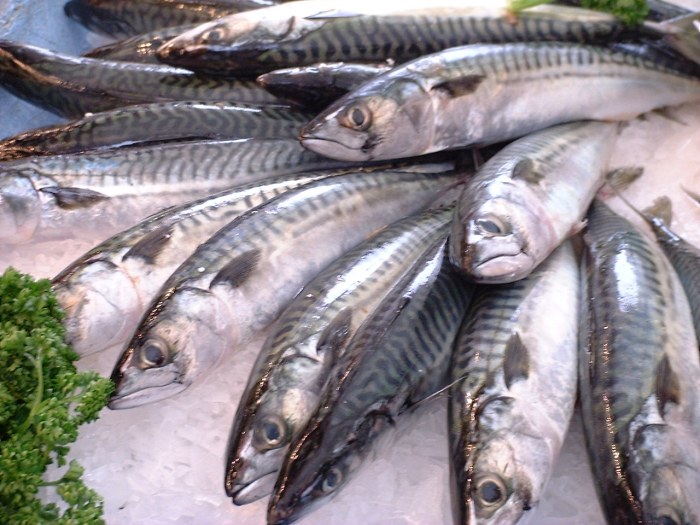 WorldMackerel
A group of pelagic fish known for their speed, stripes, and role in global fisheries.Tuna · Open ocean
 🇳🇴 Norway and 2 moreAtlantic mackerel
Fast-swimming, oily fish of the North AtlanticTuna · Coasts and shelves · 1758
 WorldAtlantic bluefin tuna
Large, warm-blooded tuna of the Atlantic and Mediterranean.Tuna · Open ocean · 1758
 🇺🇸 United States and 3 morePacific bonito
Striped marine fish of the Pacific coastTuna · Coasts and shelves
More from Scombridae
All of them WorldDogtooth tuna
A large Indo-Pacific bonito prized by sport anglers.Tuna · Coasts and shelves
 WorldBullet tuna
Small, slender tuna found in tropical oceans worldwide.Tuna · Open ocean
 WorldBlue mackerel
A small, fast pelagic fish found in tropical Indo-Pacific waters.Tuna · Coasts and shelves
WorldSlender tuna
A southern ocean tuna with oily flesh and a slender build.Tuna · Open ocean