
Indo-Pacific tarpon
A migratory fish found in Indo-Pacific fresh and salt waters.
The Indo-Pacific tarpon is a silvery fish that lives in tropical waters from Africa to Australia. It moves between rivers and the sea, feeding on small prey. This species adapts to both fresh and salt water environments.
- Grows over 1 m in salt water
- Can breathe air using swim bladder
- Migrates between rivers and sea
- Larvae are transparent and eel-like
- Found from Africa to Australia
What it is
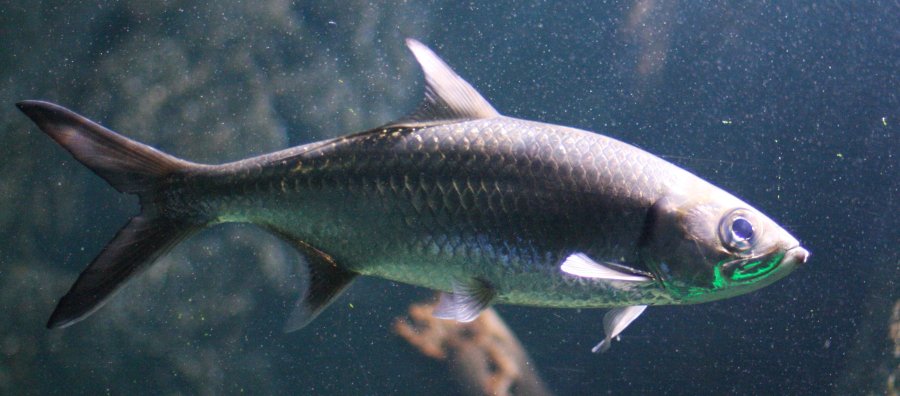
This fish resembles the larger Atlantic tarpon but is smaller. It has an olive-green back and silver sides. The mouth turns upward with a bony plate on the lower jaw. The last dorsal fin ray extends nearly to the tail. It can fill its swim bladder with air to breathe oxygen. Adults in salt water grow over one metre, while freshwater individuals stay near fifty centimetres.
Where it lives
Its range spans from East Africa and the Arabian Peninsula across South and Southeast Asia. It reaches southern Japan, French Polynesia, and southern Australia. The species inhabits coastal waters, estuaries, and inland rivers. It lives in coral reefs, mangroves, swamps, lakes, and reservoirs. In Papua New Guinea, it hides under mats of floating weeds. It thrives in tropical, brackish, and fresh waters.
How it lives
These fish are opportunistic feeders. They eat smaller fish, crustaceans, and occasionally plants. In the sea, they prefer prawns and herring. Freshwater populations consume prawns and bony bream. They migrate between open seas and inland rivers. Juveniles stay inshore until they mature. The species completes its larval metamorphosis in ten days. Larvae are flat, transparent, and eel-like.
Breeding and life cycle
Spawning occurs mainly offshore, typical for its order. They breed twice a year in both fresh and salt water. After hatching, larvae migrate from the sea into inland waters. This amphidromous behaviour allows them to mature in coastal areas before returning to spawn. Unlike some relatives, they do not require specific salinity levels for breeding.
Fish and people
Locals in Bengal call it koral fish. Indonesians know it as moon fish. In Vietnam, it is the large congee fish. People in Odisha refer to it as Pani akhia. It is caught in commercial fisheries, though exact landing data are unknown. The fish is common throughout its vast range. Museums hold over three hundred specimens for study.
Status and threats
Population data are deficient. Commercial landings and human impacts are not well recorded. Despite this lack of data, the species remains extremely common across its distribution. No specific conservation threats like dams or pollution are detailed in the records. Its wide range likely helps maintain stable numbers.


Questions people ask about Indo-Pacific tarpon
Is the Indo-Pacific tarpon a true herring?
No, it is not a member of the herring family. It is called oxeye herring only because it looks similar. It belongs to the order Elopiformes and is related to the Atlantic tarpon instead.
How big does this fish get?
Size depends on the water type. In salt water, they grow over one metre long. In fresh water, they tend to be smaller, reaching just over fifty centimetres in length.
Where can you find this fish?
It lives in tropical Indo-Pacific waters. You can find it from East Africa to Australia. It inhabits coastal seas, estuaries, mangroves, and inland rivers and lakes.
What does the Indo-Pacific tarpon eat?
It is an opportunistic feeder. Its diet includes smaller fish, crustaceans, and prawns. In fresh water, it eats bony bream. It rarely consumes plants.
Good reading and sources
- Indo-Pacific tarpon on WikipediaEncyclopedia
- More photos on Wikimedia CommonsPhotos
- Wikidata recordOpen data
The facts on this page come from the Wikipedia article "Indo-Pacific tarpon", written by its contributors and used under the CC BY-SA 4.0 licence, and from its Wikidata record (CC0). EveryFish rewrote the text in its own words, with AI assistance, and compares every page with the article to make sure no passage is copied. It may be reused under the same CC BY-SA 4.0 licence with a link back.
It may contain mistakes, and figures change over time. Nothing here is investment or buying advice. If something is wrong, tell us. Last refreshed 2026-11-15.
Like Indo-Pacific tarpon
All other fish 🇹🇷 Turkey and 4 moreAnchovy
Small, oily forage fish found in oceans and some rivers worldwide.Herring · Coasts and shelves
 WorldSeahorse
Small marine fish with horse-like heads and curled tails in the genus Hippocampus.Other · Coasts and shelves
 🇦🇷 Argentina and 4 moreArgentinian silverside
A large, adaptable silverside native to South America.Other · Rivers and lakes
 🇩🇪 Germany and 4 moreEuropean smelt
Small coastal fish with a cucumber scentOther · Rivers and lakes
