
Atlantic tarpon
Large, acrobatic saltwater game fish of the Atlantic.
The Atlantic tarpon is a large, ancient ray-finned fish found in tropical and subtropical Atlantic waters. Valued for its fighting spirit and aerial leaps, it is a premier target for recreational anglers despite having poor food quality.
- Can breathe air using its swim bladder as a primitive lung
- Grows up to 2.5 m long and weighs 161 kg
- Spawns in open ocean aggregations after reaching maturity at eight years
- Larvae do not eat and have low energy requirements
- Depicted in Michelangelo's Sistine Chapel fresco
What it is
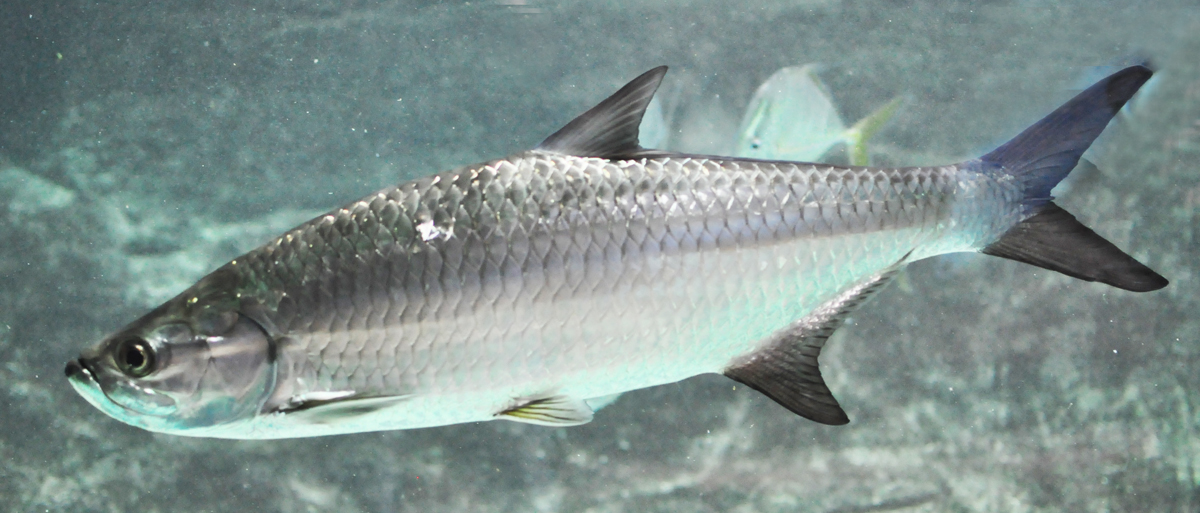
The Atlantic tarpon is a large, ancient ray-finned fish that evolved roughly 18 million years ago. It features greenish or bluish coloring on its back and silver sides, with large eyes and an upward-turned mouth containing a bony plate. The last ray of its dorsal fin extends nearly to the tail. Adults can reach lengths of 2.5 meters and weigh up to 161 kilograms, though males rarely exceed 100 pounds. A unique trait is its ability to fill its swim bladder with air, functioning like a primitive lung to survive in low-oxygen water.
Where it lives
This species inhabits both sides of the Atlantic Ocean in tropical and subtropical zones. In the west, it populates the Gulf of Mexico, Florida, and the West Indies, with sightings as far north as Nova Scotia and south to Argentina. The eastern range extends from Senegal to the Congo. Tarpon tolerate a wide salinity range, living in coastal waters, estuaries, and rivers like the Rio San Juan. They prefer temperatures between 22 and 28 degrees Celsius, becoming inactive below 16 degrees and facing lethal risks under 4 degrees.
How it lives
Tarpon are highly migratory and often cross international boundaries, sometimes moving through the Panama Canal. Their diet shifts with age: larvae absorb nutrients from water, juveniles eat zooplankton, and adults consume fish, crabs, and shrimp. They adapt well to urban environments and are primarily nocturnal around humans. Significant predators include sharks and people. Their armored scales and ability to thrive in stagnant, low-oxygen backwaters help protect juveniles from other predators until they migrate to nearshore habitats at about three years old.
Breeding and life cycle
Atlantic tarpon spawn in aggregations in the open ocean. They share a unique larval stage called leptocephalus with eels and bonefish. These slender larvae do not eat, as their bodies have low energy requirements, and their forward-pointing teeth keep debris out. Juveniles move inshore to stagnant waters. Sexual maturity arrives at around eight years of age, when fish begin gaining girth alongside length. Growth rates diverge then, with females growing faster than males. Mature fish migrate to join spawning groups.
Fish and people
Known as the Silver King, this fish is prized for sport due to its strength and spectacular aerial leaps. It is the largest species targeted by fly fishermen in shallow water. The flesh is considered poor quality, often described as smelly and bony, so catch-and-release is common in places like Florida and Alabama, where permits are required to keep one. Historically, scales were used as nail files and in traditional medicine in Brazil. An image of the fish appears in Michelangelo’s Sistine Chapel fresco. It is the official state saltwater fish of Alabama.
Status and threats
Conservation management is challenging because tarpon are highly migratory and cross international borders. Little has been documented regarding their specific migration patterns since they are not commercially valuable as food. In some US states, regulations protect the population by limiting harvest. For example, Texas only allows keeping potential state records over 75 inches. The species faces threats from habitat changes but adapts well to varied water qualities.


Questions people ask about Atlantic tarpon
Why is the Atlantic tarpon called the Silver King?
Anglers use this name because of the fish's large size, impressive armored scales, and silver coloration on its sides. It is also revered for its fighting spirit and acrobatic leaps when hooked.
Is Atlantic tarpon good to eat?
No, it is generally considered to be of poor food quality. The flesh is commonly described as smelly and bony. While subsistence fisheries exist, most recreational fishing is catch and release.
How does the tarpon survive in low-oxygen water?
It can fill its swim bladder with air, which acts like a primitive lung. This adaptation allows it to live in stagnant backwaters and estuaries where oxygen levels are too low for many other fish.
Where do Atlantic tarpon spawn?
They spawn in aggregations in the open ocean. After hatching, the larvae drift and develop before moving inshore to juvenile habitats such as mangroves and stagnant waters.
Good reading and sources
- Atlantic tarpon on WikipediaEncyclopedia
- More photos on Wikimedia CommonsPhotos
- Wikidata recordOpen data
The facts on this page come from the Wikipedia article "Atlantic tarpon", written by its contributors and used under the CC BY-SA 4.0 licence, and from its Wikidata record (CC0). EveryFish rewrote the text in its own words, with AI assistance, and compares every page with the article to make sure no passage is copied. It may be reused under the same CC BY-SA 4.0 licence with a link back.
It may contain mistakes, and figures change over time. Nothing here is investment or buying advice. If something is wrong, tell us. Last refreshed 2026-11-15.
Like Atlantic tarpon
All other fish 🇺🇸 United States and 2 moreGar
Ancient armored fish with lung-like swim bladders found in North American waters.Ancient · Rivers and lakes · 1758
 🇩🇪 Germany and 4 moreEuropean smelt
Small coastal fish with a cucumber scentOther · Rivers and lakes
 🇦🇷 Argentina and 4 moreArgentinian silverside
A large, adaptable silverside native to South America.Other · Rivers and lakes
 North AmericaAtlantic croaker
Noisy marine fish of the western Atlantic coastOther · Coasts and shelves
