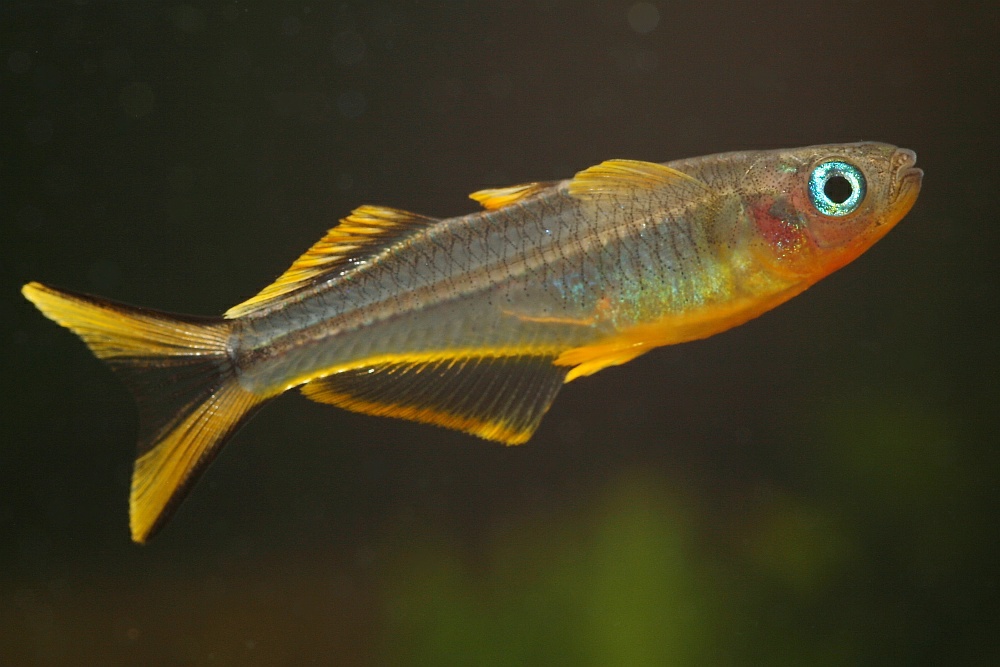
Forktail blue-eye
A small freshwater fish from Papua New Guinea rainforests.
The forktail blue-eye is a tiny ray-finned fish native to rainforest streams in Papua New Guinea. It belongs to the family Pseudomugilidae and was once classified under different genera. This species is popular in the aquarium trade due to its distinctive appearance and manageable size.
- Native to rainforest streams in Papua New Guinea
- Previously classified as Popondetta or Popondichthys
- Found in the aquarium trade
- Endemic to the area south-east of Popondetta
What it is
The forktail blue-eye is a small freshwater fish belonging to the family Pseudomugilidae. It features a forked tail and is part of the ray-finned fish group. Previously, scientists placed it in the genus Popondetta or even created a separate genus called Popondichthys. These classifications are now viewed as incorrect, and both names are treated as synonyms of Pseudomugil. The fish is known for its delicate structure and specific habitat requirements.
Where it lives
This species is endemic to Papua New Guinea, meaning it is found nowhere else in the world. Its distribution is limited to the area south-east of Popondetta. Within this region, the fish inhabits clear rainforest streams. These waterways provide the specific environmental conditions necessary for its survival, including stable temperatures and clean water sources typical of tropical forest ecosystems.
How it lives
Information regarding the specific behaviour, diet, and schooling habits of the forktail blue-eye is not detailed in the available records. As a member of the Pseudomugilidae family, it likely shares general traits with other blue-eyes, such as living in groups. However, specific details about its predators or daily activities in the wild remain unspecified in the current documentation.
Fish and people
The forktail blue-eye is occasionally found in the aquarium trade. Hobbyists value it for its unique appearance and rarity compared to more common blue-eye species. Keeping this fish requires attention to water quality that mimics its natural rainforest stream environment. It is not noted for any role in local food traditions or cultural practices beyond its appeal to aquarists.
Status and threats
The conservation status of the forktail blue-eye is not explicitly stated in the provided information. As an endemic species with a limited range near Popondetta, it may be sensitive to habitat changes.

Questions people ask about Forktail blue-eye
Where does the forktail blue-eye live?
It is endemic to Papua New Guinea, specifically in rainforest streams located south-east of Popondetta. It does not occur naturally in any other part of the world.
What is the scientific name of this fish?
The accepted scientific name is Pseudomugil furcatus. Older names like Popondetta and Popondichthys are now considered synonyms and are no longer used in valid taxonomy.
Is this fish kept in aquariums?
Yes, the forktail blue-eye may be found in the aquarium trade. It is valued by enthusiasts who can provide the specific water conditions found in its natural rainforest stream habitat.
Good reading and sources
- Forktail blue-eye on WikipediaEncyclopedia
- More photos on Wikimedia CommonsPhotos
- Wikidata recordOpen data
The facts on this page come from the Wikipedia article "Forktail blue-eye", written by its contributors and used under the CC BY-SA 4.0 licence, and from its Wikidata record (CC0). EveryFish rewrote the text in its own words, with AI assistance, and compares every page with the article to make sure no passage is copied. It may be reused under the same CC BY-SA 4.0 licence with a link back.
It may contain mistakes, and figures change over time. Nothing here is investment or buying advice. If something is wrong, tell us. Last refreshed 2026-11-15.
Like Forktail blue-eye
All killifish and livebearers 🇲🇽 Mexico and 3 moreXiphophorus
A genus of small livebearing fish native to Mexico and Central America, known for aquarium use and genetic research.Livebearer · Rivers and lakes
 WorldKillifish
Small egg-laying fish known for hardiness and short lifespansLivebearer · Rivers and lakes
 WorldAphyosemion
A large genus of small African killifish kept in home aquariums.Livebearer · Rivers and lakes
 🇺🇸 United StatesLeast killifish
A tiny North American fish that gives birth to live young and measures just two centimetres long.Livebearer · Rivers and lakes