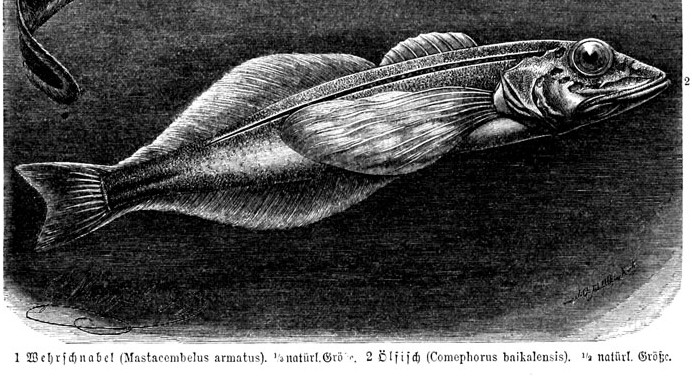
European bullhead
Small freshwater sculpin found in European rivers and streams.
The European bullhead is a small bottom-dwelling fish native to cold, clear waters across much of Europe. It features a broad head and mottled brown colouring, living in streams and lakes. Males guard nests of eggs laid by multiple females during spring spawning.
- Males guard nests for about a month in spring
- Lives in cold clear streams and brackish Baltic waters
- Pectoral fins flare like wings when resting on bottom
- Recently split into fourteen distinct species by scientists
What it is
This small demersal fish belongs to the sculpin family. It has a large, broad head that tapers into a body with large fins and a rounded tail. Eyes sit near the top of the head. When resting on the riverbed, its pectoral fins flare out like wings. The skin is light brown with darker mottling, while pelvic fins remain colourless without stripes. Adults typically reach lengths between six and eight centimetres.
Where it lives
The species inhabits cold, clear, fast-flowing small streams and middle-sized rivers. It also lives on gravelly shores of cold lakes and tolerates diluted brackish water in the Northern Baltic Sea. Its distribution covers most of the European subcontinent and the United Kingdom. It is absent from southern peninsulas and Northern Scandinavia. The population consists of genetically differentiated subunits rather than a single uniform group.
How it lives
It feeds on benthic insects, crustaceans, and other invertebrates found on the river bottom. The fish distinguishes itself from the alpine bullhead by having pelvic fin rays of similar length. Unlike the fourhorn sculpin, its dorsal and anal fins end close to the tail, creating a short caudal peduncle. These physical traits help identify it among other freshwater sculpins in Northern Europe.
Breeding and life cycle
Spawning occurs in spring. The male excavates a shallow hollow in the substrate. Several females deposit batches of eggs into this nest. The male then guards the clutch for approximately one month until the eggs hatch. This parental care ensures higher survival rates for the developing young in their early stages.
Fish and people
In the United Kingdom, conservation authorities often refer to local populations as Cottus gobio, though recent studies classify British bullheads as Cottus perifretum. The fish is known colloquially as the miller's thumb or cob. It holds no major commercial fishing value but is recognised by anglers and naturalists for its distinct appearance and behaviour in clean water systems.
Status and threats
Taxonomic reviews have split the traditional European bullhead into fourteen distinct species. Six were previously described, while eight were newly named in 2005. Examples include Cottus perifretum in Britain and Cottus rhenanus in Germany. Despite these scientific distinctions, common usage still largely groups them under the original name. One taxon, Cottus ferrugineus, is considered invalid.


Questions people ask about European bullhead
What does a European bullhead look like?
It has a large broad head, tapering body, and large fins with a rounded tail. The colour is light brown with darker mottling. Pectoral fins spread out like wings when it rests on the riverbed.
Where can you find this fish?
It lives in cold clear streams, middle-sized rivers, and gravelly lake shores across Europe and the UK. It also survives in diluted brackish water in the Northern Baltic Sea.
How does the European bullhead reproduce?
In spring, the male digs a shallow hollow. Several females lay eggs in this nest. The male stays to guard the eggs for about a month until they hatch.
Is it the same species across Europe?
No. Studies suggest it comprises fourteen distinct species. For example, British populations are often classified as Cottus perifretum, while others live in France, Germany, and Romania.
Good reading and sources
- European bullhead on WikipediaEncyclopedia
- More photos on Wikimedia CommonsPhotos
- Wikidata recordOpen data
The facts on this page come from the Wikipedia article "European bullhead", written by its contributors and used under the CC BY-SA 4.0 licence, and from its Wikidata record (CC0). EveryFish rewrote the text in its own words, with AI assistance, and compares every page with the article to make sure no passage is copied. It may be reused under the same CC BY-SA 4.0 licence with a link back.
It may contain mistakes, and figures change over time. Nothing here is investment or buying advice. If something is wrong, tell us. Last refreshed 2026-11-15.
Like European bullhead
All other fish 🇨🇺 CubaCuban gar
Large tropical freshwater predator native to western Cuba.Other · Rivers and lakes
 WorldFeatherbacks and knifefishes
Freshwater bony-tongued fishes with long anal finsOther · Rivers and lakes
 WorldNile perch
Large freshwater predator native to Africa, now invasive in many lakes.Other · Rivers and lakes
 WorldThree-spined stickleback
Small northern fish known for rapid evolution and complex breeding.Other · Rivers and lakes