Comephorus
Two species of pelagic sculpins endemic to Lake Baikal in Russia.
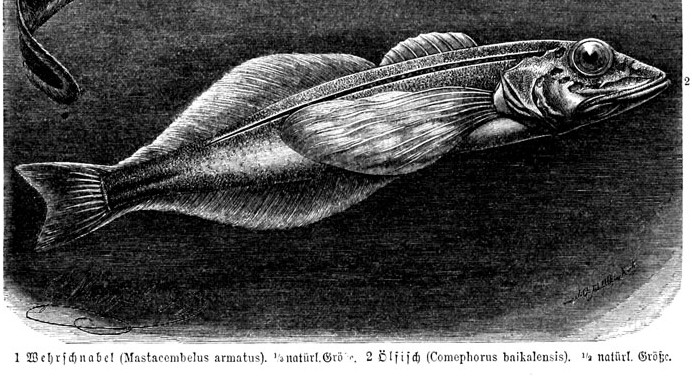
Comephorus is a genus of two fish species found only in Lake Baikal. They are the main food for the Baikal seal and have unique adaptations like high oil content and live birth.
- High lipid content makes up to 38.9% of body weight in big species.
- Viviparous females give birth to 2000-3000 larvae annually.
- Primary food source for the Baikal seal, comprising over 90% of diet.
- Live in cold water below 5°C and can dive to 1.6 km depth.
- Translucent bodies lack scales and swim bladders.
What it is
Comephorus includes two species of sculpin known as golomyankas or Baikal oilfish. These fish inhabit Lake Baikal in Russia. They have translucent bodies without scales, which look dull after death. The big Baikal oilfish grows up to 21 cm, while the little one reaches 16 cm. Males are smaller than females. They possess long pectoral fins but lack pelvic fins despite having pelvic bones. Their bones are porous and their bodies contain high lipid levels. This gives them near-neutral buoyancy and removes the need for a swim bladder. They can handle pressure changes as they move through different water depths.
Where it lives
These fish live throughout the entire water column of Lake Baikal. They range from near the surface down to 1.6 km deep. They prefer cold water no warmer than 5 °C and die at 10 °C. During night hours, they rise to shallower depths of 10–25 m to feed. In winter, they may swim just below the ice. They are considered the most abyssal freshwater fish alongside other deep-water sculpins. They avoid large schools, though small groups of about 20 individuals appear near the lake bottom.
How it lives
Golomyankas are sluggish swimmers with large mouths containing brush-like teeth. They sift fine organisms from the water. Their diet consists mainly of the copepod Epischura baikalensis and the amphipod Macrohectopus branickii. They also eat sculpin larvae, including their own kind. They serve as the primary food source for the Baikal seal, making up over 90% of its diet. They compete ecologically with the omul fish. Their biomass is estimated at 150 thousand tons, representing about 70% of all fish in the lake. Females outnumber males significantly in both species.
Breeding and life cycle
Females do not lay eggs but are viviparous. They give birth to swarms of 2000–3000 larvae. Births occur year-round but peak between August and April. Most females die shortly after giving birth. A myth claims their bellies burst open during this process, but this is false. They reach an age of up to 6–8 years. Juveniles are the most abundant pelagic fish larvae in the lake. The rapid spawning helps maintain their massive population numbers within the ecosystem.
Fish and people
Golomyankas are difficult to catch because they do not form large schools. They are not harvested commercially. Historically, native Siberians used their fats and oils for lamps and traditional medicine when storms washed them ashore. They hold no value as food for humans, dogs, or cats. However, they are crucial for the Baikal seal's survival. Their high numbers prevent ecosystem imbalance by serving as constant prey for predators. Without these predators, their biomass would disrupt the lake's ecology.
Status and threats
The species are classified as least concern due to their vast numbers. They represent the largest concentration of fish biomass in Lake Baikal. Their population is stable because predators keep their numbers in check. No specific threats like pollution or dams are mentioned for this genus. Their adaptation to cold water and deep pressure allows them to thrive in their unique habitat. Conservation efforts focus on maintaining the health of the Baikal ecosystem rather than targeting these fish directly.


Questions people ask about Comephorus
What are golomyankas?
Golomyankas are common names for fish in the genus Comephorus. They are pelagic sculpins endemic to Lake Baikal in Russia. There are two recognized species: the big Baikal oilfish and the little Baikal oilfish. They are known for their high oil content and live birth.
How do they reproduce?
Female golomyankas are viviparous, meaning they give birth to live young instead of laying eggs. Each female produces between 2000 and 3000 larvae. Births happen year-round but peak from August to April. Most females die shortly after giving birth to their offspring.
Why are they called oilfish?
They are called Baikal oilfish because their bodies contain very high levels of lipids. Up to 38.9% of the big species' body weight is oil. This high lipid content provides near-neutral buoyancy and eliminates the need for a swim bladder.
Are they safe to eat?
Golomyankas are not harvested commercially and are not considered a food source for humans. They also have no value as food for dogs or cats. Native Siberians historically used their fats for lamps and traditional medicine, but they are not eaten as meat.
Where do they live?
They live exclusively in Lake Baikal in Russia. They are pelagic fish found throughout the entire water column. They range from near the surface down to 1.6 km deep. They prefer cold water temperatures no higher than 5°C.
Good reading and sources
The facts on this page come from the Wikipedia article "Comephorus", written by its contributors and used under the CC BY-SA 4.0 licence, and from its Wikidata record (CC0). EveryFish rewrote the text in its own words, with AI assistance, and compares every page with the article to make sure no passage is copied. It may be reused under the same CC BY-SA 4.0 licence with a link back.
It may contain mistakes, and figures change over time. Nothing here is investment or buying advice. If something is wrong, tell us. Last refreshed 2026-11-15.
Like Comephorus
All other fish 🇷🇺 Russia and 3 moreBurbot
A coldwater freshwater fish with a chin whisker, native to the Northern Hemisphere.Other · Rivers and lakes · 1758
 🇧🇼 Botswana and 1 moreAfrican tigerfish
Predatory freshwater fish known for sharp teeth and leaping hunting behaviour.Other · Rivers and lakes · 1861
 🇺🇬 Uganda and 2 moreSilver cyprinid
A small pelagic fish from Lake Victoria that supports regional food security.Other · Rivers and lakes
 🇵🇭 Philippines and 4 moreMilkfish
The sole living species of the family Chanidae, found across the Indo-Pacific.Other · Coasts and shelves
