
Common guitarfish
A critically endangered cartilaginous fish native to the eastern Atlantic and Mediterranean.
The common guitarfish is a bottom-dwelling shark relative found in the eastern Atlantic and Mediterranean. It faces severe population declines due to coastal trawling and bycatch, leading to its classification as critically endangered.
- Grows up to 147 cm but usually reaches 80 cm
- Listed as critically endangered by the IUCN
- Gives birth to live young in litters of four to ten
- Has disappeared from the northern Mediterranean
- Caught mainly as bycatch in shrimp and cephalopod trawls
What it is
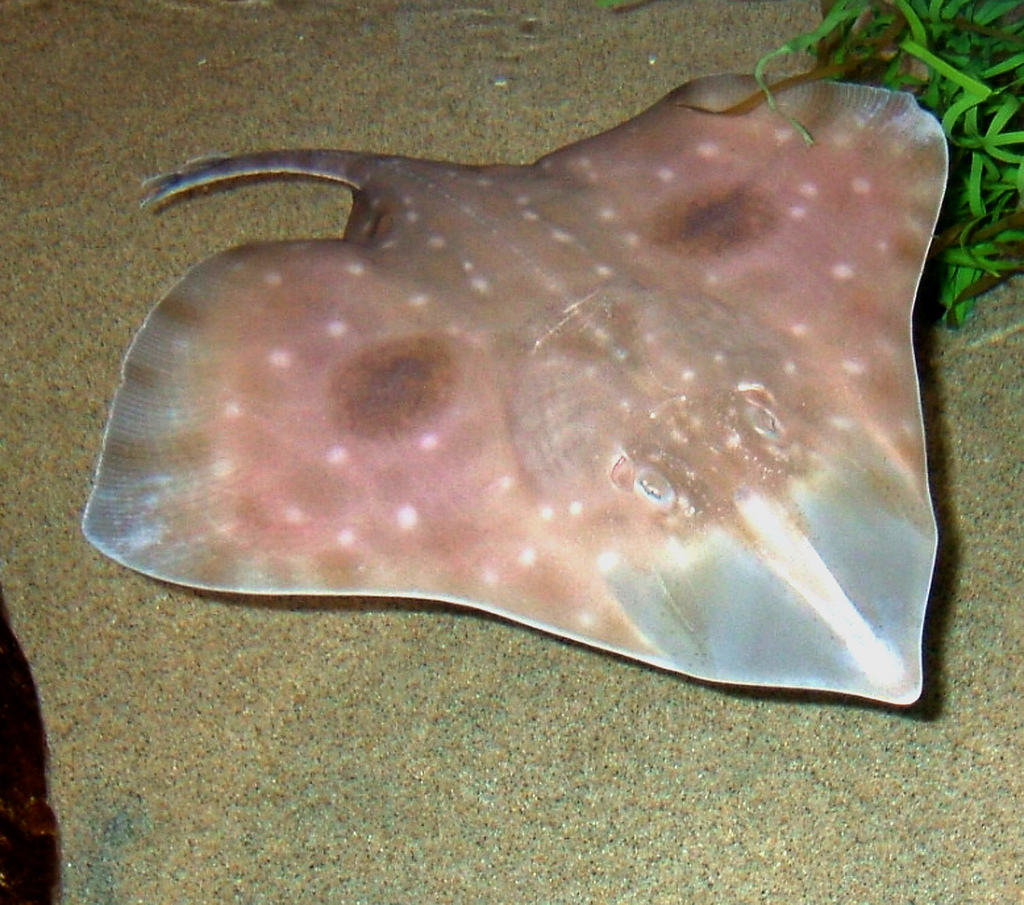
This cartilaginous fish belongs to the family Rhinobatidae. It has a khaki-brown upper surface and white underparts. Adults can reach 147 cm, though 80 cm is more typical. The body shape resembles a guitar, with a flattened head and fused pectoral fins. It lives on the sea floor, often partially burying itself in sand or mud. Its appearance is similar to the blackchin guitarfish, but it has larger eyes and different nasal features.
Where it lives
Its habitat spans the eastern Atlantic Ocean, ranging from the Bay of Biscay down to Angola. It also inhabits the southern Mediterranean Sea. The fish prefers sandy or muddy bottoms where it can rest and hide. It stays close to the coast and breeds in shallow waters. This proximity to shore makes it accessible to various fishing gears. It has disappeared from some historical areas, including the Balearic Islands and parts of the northern Mediterranean.
How it lives
As a benthic species, it cruises slowly just above the seabed. It feeds on crustaceans, other invertebrates, and small fish. The animal is not highly active, often resting on the sediment. Its slow movement and coastal preference expose it to frequent contact with fishing nets. It does not form large schools but is often caught alongside other bottom-dwelling species. Predation pressure is high from industrial and artisanal fishing operations.
Breeding and life cycle
Females give birth to live young rather than laying eggs. This reproductive strategy is known as ovoviviparity. The embryos develop inside the mother, initially feeding on yolk sacs. Later, they receive nourishment from uterine secretions. The gestation period lasts about four months. Each year, a female produces one or two litters, with each containing four to ten pups. This low reproductive rate makes population recovery difficult when adult numbers drop.
Fish and people
Fishermen catch this species primarily as bycatch in shrimp trawls and cephalopod fisheries. Local artisans also use gill nets. In the past, ports like Palermo landed significant catches. Today, it is rarely seen in those areas. The meat is sometimes salted for export, and fins are sold to Asian markets. Most individuals caught in the southern Mediterranean are immature, which threatens future stock levels. There is no specific conservation plan in place.
Status and threats
The International Union for Conservation of Nature lists it as critically endangered. Populations have declined sharply across its range. It has been extirpated from the northern Mediterranean and the Balearic Islands. Fishing pressure remains high, particularly from trawling vessels off West Africa. The capture of immature fish prevents successful breeding. Without measures to protect adults and allow them to mature, the species faces a uncertain future.

Questions people ask about Common guitarfish
What does the common guitarfish eat?
It feeds on crustaceans, other invertebrates, and small fish. As a bottom-dweller, it forages along the sandy or muddy seabed for these prey items.
Why is the common guitarfish endangered?
It is vulnerable to trawling and gill nets because it lives in shallow coastal waters. High rates of bycatch and the removal of immature fish have caused severe population declines.
How does the common guitarfish reproduce?
Females are ovoviviparous, meaning they give birth to live young. Embryos develop inside the mother, feeding on yolk and uterine secretions, with litters of four to ten pups born yearly.
Good reading and sources
- Common guitarfish on WikipediaEncyclopedia
- More photos on Wikimedia CommonsPhotos
- Wikidata recordOpen data
The facts on this page come from the Wikipedia article "Common guitarfish", written by its contributors and used under the CC BY-SA 4.0 licence, and from its Wikidata record (CC0). EveryFish rewrote the text in its own words, with AI assistance, and compares every page with the article to make sure no passage is copied. It may be reused under the same CC BY-SA 4.0 licence with a link back.
It may contain mistakes, and figures change over time. Nothing here is investment or buying advice. If something is wrong, tell us. Last refreshed 2026-11-15.
Like Common guitarfish
All sharks WorldSchool shark
A temperate houndshark valued for liver oil and meat.Shark · Coasts and shelves
 WorldAngelshark
Flat-bodied sharks that bury themselves in sandy seabeds to ambush prey.Shark · Coasts and shelves · 1758
 WorldSkate
Cartilaginous fish with flat bodies and egg cases, found on sea floors worldwide.Shark · Coasts and shelves
 WorldSalmon shark
A warm-blooded mackerel shark of the northern PacificShark · Coasts and shelves
