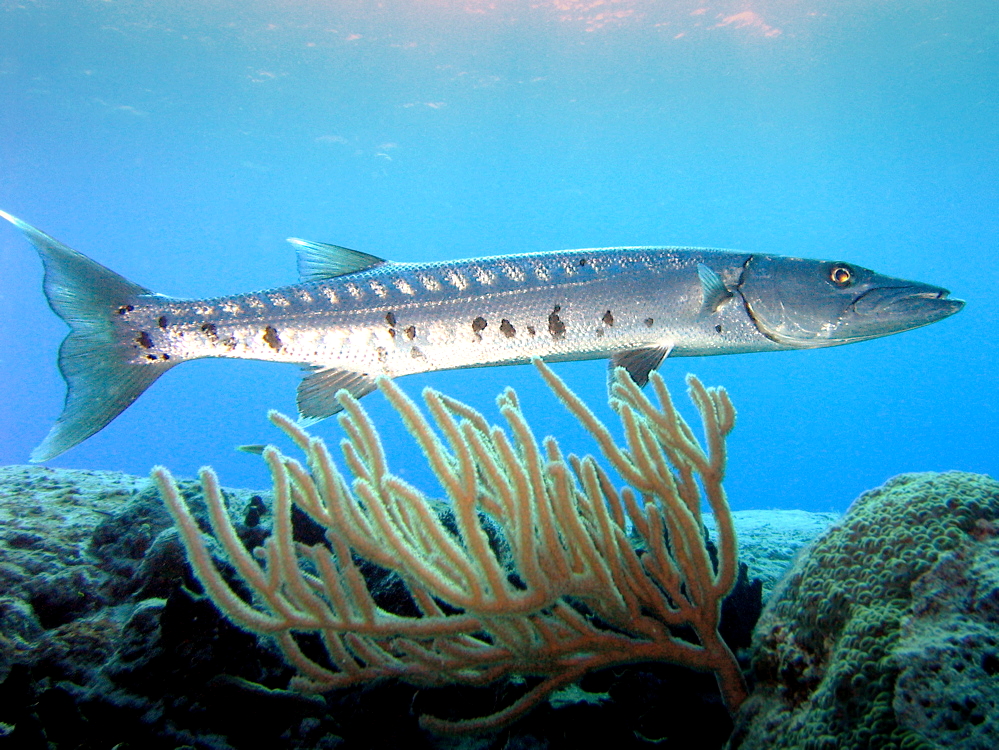
Barracuda
Large predatory saltwater fish with sharp teeth found in tropical oceans.
The barracuda is a genus of large, predatory ray-finned fish known for their elongated bodies and fang-like teeth. They inhabit warm waters globally and are prized by sport fishermen and as food, though some species can carry toxins.
- Genus Sphyraena contains 26 recognized species.
- Maximum recorded length is 165 cm (65 inches).
- Can reach speeds of up to 43 km/h (27 mph).
- Family Sphyraenidae was named by Constantine Samuel Rafinesque in 1815.
- Some species cause ciguatera fish poisoning in humans.
What it is
Barracudas are large, predatory fish belonging to the genus Sphyraena, which stands alone in the family Sphyraenidae. They possess elongated bodies, large pointed heads, and an underbite in many species. Their most distinctive feature is a set of prominent, sharp-edged, fang-like teeth set in large jaws. The body is typically dark gray, green, or blue on top, fading to silvery sides and a white belly. Some species display irregular black spots or cross-bars. They have two widely separated dorsal fins, a prominent lateral line, and a moderately forked tail fin that aids in rapid movement.
Where it lives
These fish are found in tropical and subtropical oceans across the globe. Their distribution stretches from the eastern Atlantic Ocean to the Red Sea, through the Caribbean Sea, and into the Pacific Ocean. They inhabit coastal areas, often swimming near coral reefs and sea grass beds. While most live in saltwater, certain species like the great barracuda can also tolerate brackish water environments. They are commonly found in shallow waters where they hunt schools of smaller fish.
How it lives
Barracudas are opportunistic predators that rely on surprise and bursts of speed, reaching up to 43 km/h, to catch prey. Adults are usually solitary, while juveniles often form groups. They feed primarily on other fish, such as jacks, grunts, and herrings, often biting them in half or tearing chunks out of larger prey. Their silver bodies help them remain hidden from prey, especially when viewed head-on. They hunt using keen eyesight, targeting unusual colors or movements. Occasionally, they swim in groups to corner fish schools into shallow water or compact areas for easier feeding.
Fish and people
Barracudas are popular targets for sport fishing due to their fighting ability. They are also consumed as food, often prepared as fillets or steaks. In West Africa, smoking is used to preserve the flesh for soups and sauces. Thai cuisine uses the meat in curries or steamed in banana leaves, while Chinese preparations often involve steaming. However, larger species can accumulate ciguatera toxin, causing poisoning symptoms like gastrointestinal distress and temperature sensation reversal in humans. Fatalities from attacks on humans are rare but have been reported.


Questions people ask about Barracuda
What does a barracuda look like?
Barracudas have elongated bodies, large pointed heads, and prominent fang-like teeth. They are typically dark gray, green, or blue on top with silvery sides and a white belly. Many species have two widely separated dorsal fins and a forked tail.
Are barracudas dangerous to humans?
Attacks on swimmers are rare and often linked to poor visibility or mistaken identity. Barracudas may mistake shiny jewelry for prey. Fatalities are extremely uncommon, with only a few historical reports in Florida and North Carolina.
Can you eat barracuda?
Yes, barracuda is eaten as fillets or steaks and is popular in various cuisines, including West African, Thai, and Chinese dishes. However, larger species can carry ciguatera toxin, which causes illness if consumed.
Where do barracudas live?
They inhabit tropical and subtropical oceans worldwide, including the Atlantic, Pacific, and Indian Oceans. They are commonly found near coral reefs, sea grass beds, and coastal waters, sometimes entering brackish water.
Good reading and sources
The facts on this page come from the Wikipedia article "Barracuda", written by its contributors and used under the CC BY-SA 4.0 licence, and from its Wikidata record (CC0). EveryFish rewrote the text in its own words, with AI assistance, and compares every page with the article to make sure no passage is copied. It may be reused under the same CC BY-SA 4.0 licence with a link back.
It may contain mistakes, and figures change over time. Nothing here is investment or buying advice. If something is wrong, tell us. Last refreshed 2026-11-15.
Like Barracuda
All sharks WorldGalapagos shark
Large requiem shark of tropical oceanic islandsShark · Coasts and shelves · 1905
 WorldGrouper
Marine ray-finned fish in the family Epinephelidae, known for large size and commercial value.Shark · Coasts and shelves
 WorldGiant trevally
Large marine jack found across the Indo-Pacific, known for size and hunting skill.Other · Coasts and shelves · 1775
 WorldBigeye scad
Tropical marine fish with large eyes and metallic blue skinOther · Coasts and shelves · 1793
More from Sphyraenidae
All of them WorldGreat barracuda
Large predatory fish found in warm oceans worldwide.Other · Coasts and shelves
 WorldObtuse barracuda
A small barracuda species found in tropical seas across the globe.Other · Open ocean
 WorldPickhandle barracuda
A striped Indo-Pacific barracuda with a yellow tail.Other · Coasts and shelves