
Cardinalfishes
Small, colourful reef fish known for male mouthbrooding.
Cardinalfishes form the family Apogonidae, comprising about 370 species of small ray-finned fishes. They inhabit tropical and subtropical waters across the Atlantic, Indian, and Pacific Oceans. Most live in marine environments, though some enter brackish or fresh water. Males are notable for incubating eggs in their mouths.
- Family includes about 370 species of small ray-finned fishes.
- Males incubate eggs in their mouths and stop feeding.
- Most species are under 10 cm and live in coral reefs.
- Nocturnal fish that hide in crevices during the day.
What it is
Cardinalfishes belong to the family Apogonidae, which includes approximately 370 species of ray-finned fishes. These are generally small creatures, with most adults measuring under 10 centimetres. They often display bright colours and possess large mouths. A key physical trait is the dorsal fin, which splits into two separate sections. While primarily marine, a few genera such as Glossamia inhabit fresh water.
Where it lives
These fishes occupy tropical and subtropical zones within the Atlantic, Indian, and Pacific Oceans. Their primary habitat consists of coral reefs and lagoons, where they find shelter in dark crevices during daylight hours. Although chiefly marine, some species tolerate brackish conditions. The genus Glossamia represents those adapted to freshwater environments.
How it lives
Cardinalfishes are nocturnal animals. They spend the day hiding in reef structures to avoid predators and emerge at night. Their large mouths and distinct jaw structure support their reproductive strategy rather than just feeding. Males have longer heads and larger jaws than females, an adaptation that allows them to hold eggs safely inside their mouths while fasting.
Breeding and life cycle
Reproduction involves paternal mouthbrooding. Male cardinalfishes carry the fertilised eggs inside their oral cavity. During this incubation period, the males do not eat. This behaviour is facilitated by their specific head morphology, which differs from that of females. The young develop within the protection of the father's mouth until they are ready to hatch.
Fish and people
A small number of cardinalfish species are popular in the aquarium trade. Hobbyists value them for their peaceful nature, small size, and vivid colouration. They are kept as ornamental fish in home tanks.
Questions people ask about Cardinalfishes
Do cardinalfishes eat while breeding?
No, male cardinalfishes do not feed during the incubation period. They hold the eggs in their mouths to protect them, which prevents normal feeding until the young are released.
Where do cardinalfishes live?
They are found in tropical and subtropical waters of the Atlantic, Indian, and Pacific Oceans. Most inhabit marine coral reefs and lagoons, though some live in brackish or fresh water.
Are cardinalfishes good for aquariums?
Yes, a handful of species are popular in the aquarium trade. They are valued for being small, peaceful, and colourful, making them suitable for community tanks.
Good reading and sources
The facts on this page come from the Wikipedia article "Apogonidae", written by its contributors and used under the CC BY-SA 4.0 licence, and from its Wikidata record (CC0). EveryFish rewrote the text in its own words, with AI assistance, and compares every page with the article to make sure no passage is copied. It may be reused under the same CC BY-SA 4.0 licence with a link back.
It may contain mistakes, and figures change over time. Nothing here is investment or buying advice. If something is wrong, tell us. Last refreshed 2026-11-15.
Like Cardinalfishes
All reef fish WorldSea goldie
A colourful reef fish that changes sex.Perch-like · Coasts and shelves
 WorldBluespotted cornetfish
Long, slender reef fish with a tubular snout and blue spots.Reef fish · Coasts and shelves
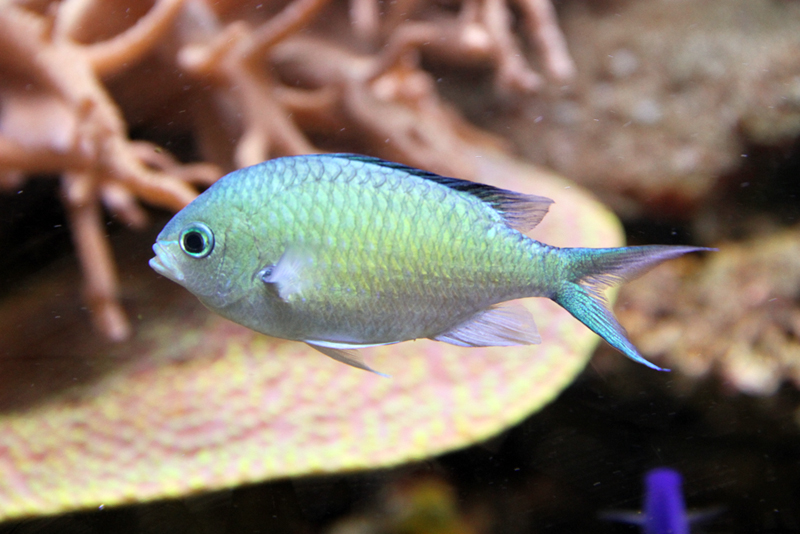 WorldGreen chromis
Small iridescent reef damselfish found across the Indo-Pacific.Reef fish · Coral reefs
 WorldSurgeonfish
Marine fish family with sharp tail spines and algae diets.Reef fish · Coasts and shelves