
Jarbua terapon
A striped Indo-Pacific fish found in seas and rivers.
The jarbua terapon is a medium-sized ray-finned fish from the Terapontidae family. It lives across the Indo-Pacific in marine and fresh waters. This species supports local fisheries and appears occasionally in aquariums due to its distinct markings.
- Reaches a maximum length of 36 centimetres
- Tolerates salinity from freshwater to 70 per cent seawater
- Acts as a cleaner fish eating parasites and scales
- Produces sounds using swimbladder muscles for communication
- First described formally in 1775 by Fabricius
What it is
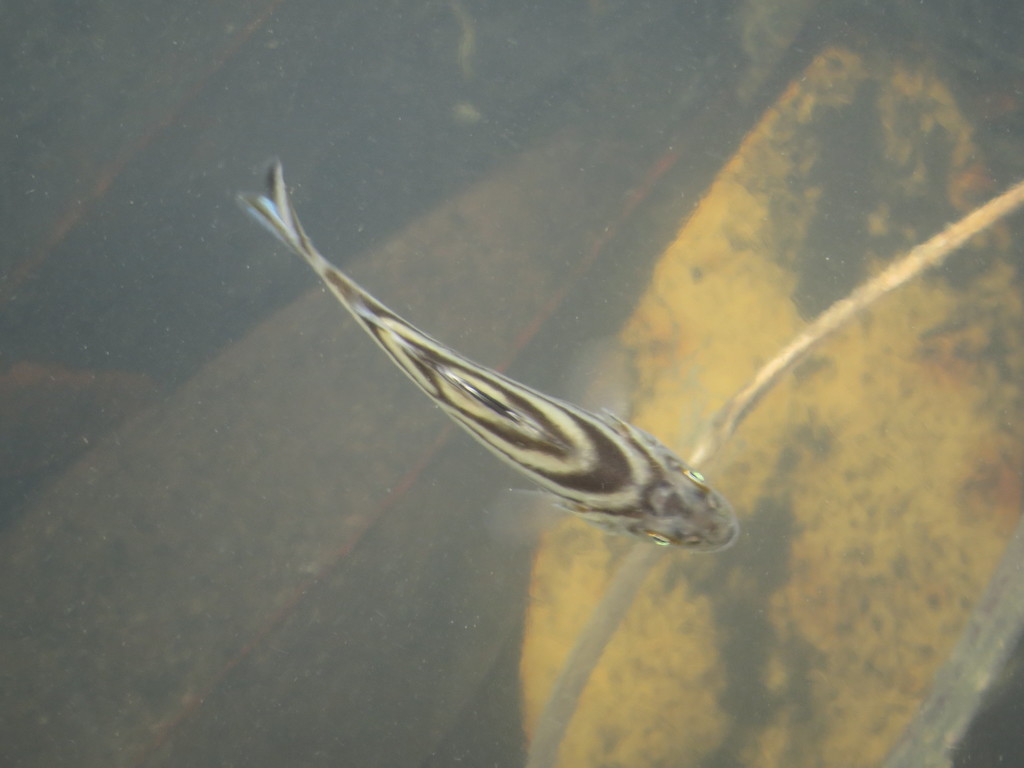
This medium-sized grunter has an oblong body that is slightly compressed from side to side. Its colour is silvery white with three or four curved stripes running from the neck to the tail. A black spot marks the spiny dorsal fin, and the tail lobes have black tips. The mouth is slanted, with jaws of equal length. Adults possess conical teeth set in bands, though the enlarged outer teeth seen in juveniles may disappear later. The dorsal fin features a strongly arched spiny section with deep notches between the fourth and sixth spines.
Where it lives
The species occupies a vast area across the Indo-Pacific region. Its distribution stretches from the Red Sea and eastern African coasts down to South Africa. It moves through the Indian Ocean, including the Persian Gulf, and extends into the Pacific as far east as Samoa. Northern limits reach Japan, while southern records include the Arafura Sea and Lord Howe Island. A single specimen appeared in the eastern Mediterranean in 2010, likely entering via the Suez Canal.
How it lives
This fish tolerates a wide range of salt levels, living in pure seawater, coastal zones, estuaries and fresh rivers. Juveniles are common in sandy intertidal zones and tidal pools. It acts as a predator on smaller fish but also serves as a cleaner, removing parasites and eating high-calorie scales from larger hosts. Diet includes insects and other invertebrates. Young fish are social but become territorial as they grow. They produce sounds using swimbladder muscles for communication, with vocalisations changing as they mature or when their environment shifts.
Breeding and life cycle
Reproduction occurs in the marine environment, even though adults and juveniles are often found in freshwater. The fish reaches sexual maturity after growing to a total length of 13 centimetres. Specific details regarding egg laying, larval development or spawning seasons are not provided in the available text, but the requirement for saltwater indicates a migratory breeding pattern between riverine habitats and the sea.
Fish and people
Local fisheries target this species using gillnets, traps, handlines and bottom trawls. Markets sell the catch fresh or preserved as dried and salted product. It holds minor importance in the aquarium trade, where enthusiasts call it the target fish because of the pattern visible from above. The distinctive markings and small scales may help it avoid attacks from others of its own kind. Its ability to live in varied salinities makes it adaptable to different capture methods and habitats.
Status and threats
Conservation status is not explicitly listed in the provided data. The species faces pressure from commercial fishing operations using various inshore gear types. Habitat modification through dam construction or pollution could affect populations, particularly those moving between fresh and salt water.


Questions people ask about Jarbua terapon
Where does the jarbua terapon live?
It inhabits the Indo-Pacific, ranging from the Red Sea to Samoa and Japan. It lives in marine waters, estuaries, coastal lagoons and freshwater rivers, tolerating a wide variety of salinity levels.
What does the jarbua terapon eat?
This predatory fish feeds on smaller fishes, insects and invertebrates. It also acts as a cleaner, removing ectoparasites from larger fish and consuming their scales, which provide a high-calorie food source.
Is the jarbua terapon used for food?
Yes, it is an important commercial species in its range. Fishers catch it using gillnets, traps and trawls, and it is sold either fresh or in a dried and salted form for consumption.
Good reading and sources
- Terapon jarbua on WikipediaEncyclopedia
- More photos on Wikimedia CommonsPhotos
- Wikidata recordOpen data
The facts on this page come from the Wikipedia article "Terapon jarbua", written by its contributors and used under the CC BY-SA 4.0 licence, and from its Wikidata record (CC0). EveryFish rewrote the text in its own words, with AI assistance, and compares every page with the article to make sure no passage is copied. It may be reused under the same CC BY-SA 4.0 licence with a link back.
It may contain mistakes, and figures change over time. Nothing here is investment or buying advice. If something is wrong, tell us. Last refreshed 2026-11-15.
Like Jarbua terapon
All other fish WorldSpotted scat
A spotted, square-bodied fish from Indo-Pacific estuaries.Other · Rivers and lakes · 1766
 WorldTank goby
Large subtropical goby found in fresh and salt waterOther · Rivers and lakes
 WorldNorthern whiting
A widespread marine fish found in the Indo-Pacific, known for its silvery body and ability to bury itself in sand.Other · Coasts and shelves · 1775
 🇺🇸 United States and 2 moreGar
Ancient armored fish with lung-like swim bladders found in North American waters.Ancient · Rivers and lakes · 1758