
Tank goby
Large subtropical goby found in fresh and salt water
The tank goby is a large carnivorous fish native to waters from East Africa to the Pacific. It inhabits estuaries and inland streams, where it feeds on small fish and invertebrates. This species is commercially fished for food and kept in home aquariums.
- Reaches a maximum length of 50 centimetres
- Found up to 300 kilometres inland in Malawi
- Both parents guard the eggs in vegetation
- Diet consists mainly of other small fish
- Sold fresh or frozen in commercial markets
What it is
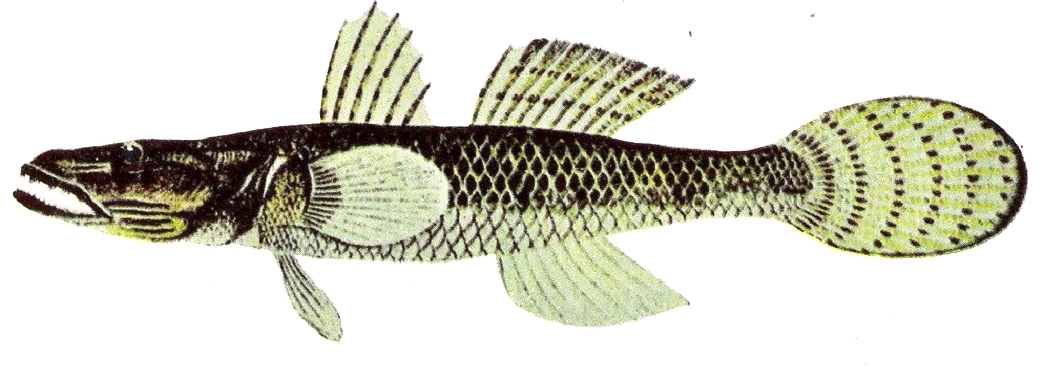
The tank goby is a substantial member of the goby family, reaching lengths of up to 50 centimetres. Its head is flattened with a lower jaw that protrudes forward, while the body becomes narrower near the tail. The skin is typically brown or light brown, marked with darker spots and flecks along its sides. This physical structure supports its life in varied water conditions across a vast geographic range.
Where it lives
This subtropical species occupies fresh, marine and brackish environments from the Red Sea and East Africa to the Pacific Ocean. It is commonly found in estuaries but travels far inland, recorded up to 300 kilometres upstream in Malawi. The fish prefers clear or turbid streams with bottoms made of rock, gravel or sand. Its distribution extends through South Asia, the Indian Ocean, China, Australia and Pacific islands.
How it lives
As a benthopelagic and amphidromous creature, this goby moves between different water types during its life. It is a strict carnivore with a short gut relative to its body length, indicating a diet of easily digested prey. Stomach content analysis shows it primarily eats other fish, followed by semi-digested matter and insects. Cannibalism occurs within the species, and it also consumes crustaceans, detritus and occasional plant material.
Breeding and life cycle
Reproduction takes place in freshwater, where adults lay eggs among submerged vegetation. Both the male and female guard the clutch until hatching. Currents often carry the eggs out to sea, although the species can complete its entire life cycle without entering saltwater. Breeding seasons vary by location, occurring in summer in South Africa and during the dry season in northern Australia.
Fish and people
Unlike many small gobies, this species is large enough for commercial exploitation. Fishers sell the catch fresh or frozen in local markets. It also appears in the aquarium trade, valued for its size and hardiness. The fish serves as a food source in regions across its wide range, supporting both subsistence and commercial fishing activities.



Questions people ask about Tank goby
How big does the tank goby get?
This species grows larger than most gobies, reaching a maximum length of 40 to 50 centimetres. Its substantial size makes it suitable for commercial fishing and distinguishes it from smaller relatives in the same family.
What does the tank goby eat?
It is a carnivore that primarily eats small fish, which make up nearly half its diet by volume. It also consumes insects, crustaceans and semi-digested food. Cannibalism has been observed, and its short gut length confirms its meat-eating habits.
Where does the tank goby live?
It inhabits fresh, marine and brackish waters from East Africa to the Pacific. While often found in estuaries, it travels far inland into freshwater streams with rocky or sandy bottoms. It can survive in both clear and turbid water conditions.
Is the tank goby used for food?
Yes, it is commercially exploited due to its large size. Fishers sell the catch fresh or frozen in markets. Its substantial meat yield makes it a viable target for commercial operations, unlike many smaller goby species.
Good reading and sources
The facts on this page come from the Wikipedia article "Tank goby", written by its contributors and used under the CC BY-SA 4.0 licence, and from its Wikidata record (CC0). EveryFish rewrote the text in its own words, with AI assistance, and compares every page with the article to make sure no passage is copied. It may be reused under the same CC BY-SA 4.0 licence with a link back.
It may contain mistakes, and figures change over time. Nothing here is investment or buying advice. If something is wrong, tell us. Last refreshed 2026-11-15.
Like Tank goby
All other fish WorldSpotted scat
A spotted, square-bodied fish from Indo-Pacific estuaries.Other · Rivers and lakes · 1766
 WorldJarbua terapon
A striped Indo-Pacific fish found in seas and rivers.Other · Rivers and lakes · 1775
 WorldSeahorse
Small marine fish with horse-like heads and curled tails in the genus Hippocampus.Other · Coasts and shelves
 WorldFeatherbacks and knifefishes
Freshwater bony-tongued fishes with long anal finsOther · Rivers and lakes