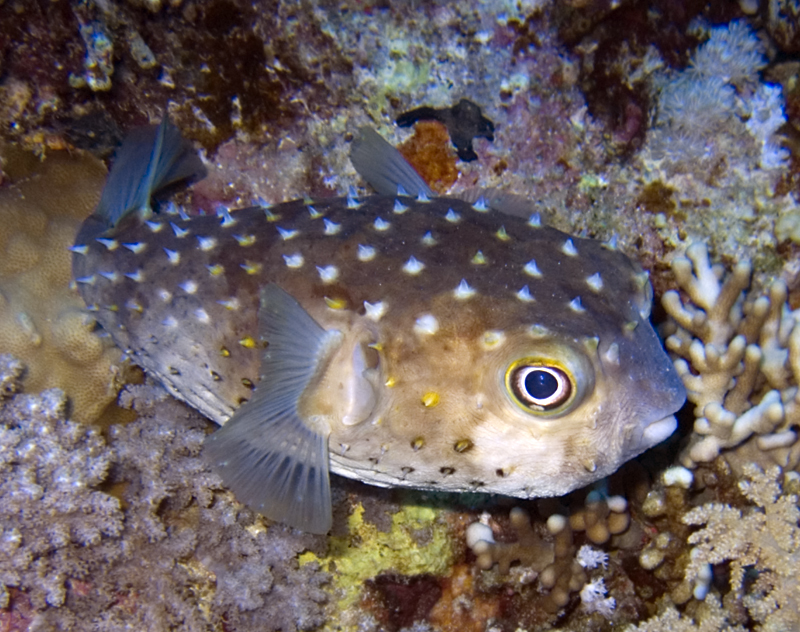
Spot-fin porcupinefish
A spiny tropical reef fish that inflates when threatened.
The spot-fin porcupinefish is a medium-sized marine species found in tropical and subtropical waters worldwide. It uses inflatable spines and toxins for defence, feeding on hard-shelled invertebrates near coral reefs.
- Grows up to 91 cm but typically reaches 40 cm
- Inflates body and raises spines when threatened
- Contains toxic tetrodotoxin in liver and skin
- Nocturnal feeder on urchins and crustaceans
- Found in tropical reefs worldwide
What it is
This medium-sized fish belongs to the family Diodontidae. It has an elongated body with a spherical head and large, protruding eyes. The mouth stays open most of the time. Large pectoral fins aid movement, while pelvic fins are missing. Dorsal and anal fins sit near the tail and move together. Smooth, firm skin covers modified scales that form sharp spines. The colour ranges from beige to sandy-yellow, marked with dark blotches and many small black spots. Adults usually reach 40 cm, though they can grow to 91 cm.
Where it lives
The species lives in tropical and subtropical seas around the world. It inhabits lagoons, top reefs, and seaward coral or rocky structures. Individuals stay at depths between one and 50 metres. During the day, they hide under ledges or in caves. Young fish live in the open water column until they reach about 20 cm in length. Records exist from the Mediterranean Sea, specifically off southern Italy and the Balearic islands, though these are rare occurrences outside its usual range.
How it lives
These fish are solitary creatures, coming together only to mate. They are most active at night, with peak activity occurring at sunset and sunrise. Their diet consists mainly of hard-shelled prey, including sea urchins, gastropods, clams, and crustaceans. When threatened, they swallow water to inflate their bodies, making themselves larger and raising their spines to deter predators. This physical defence is supported by chemical protection, as they store tetrodotoxin in organs like the liver, skin, and gonads.
Breeding and life cycle
Information on specific spawning times or egg development is not detailed in the provided text. The fish generally live alone but gather during mating periods. Juveniles begin life as pelagic organisms, drifting in open water. They remain in this stage until they grow to approximately 20 cm in length, after which they settle into reef habitats.
Fish and people
The fish contains tetrodotoxin, a potent neurotoxin concentrated in the liver, viscera, skin, and gonads. This makes it dangerous if consumed improperly. Parasites such as the larvae of the cestode Molicola horridus often infect the liver, forming visible cysts. These parasites do not pose a risk to humans. The species is known by several common names, including spotted porcupinefish and black-spotted porcupinefish.


Questions people ask about Spot-fin porcupinefish
Is the spot-fin porcupinefish poisonous?
Yes, it concentrates tetrodotoxin in its liver, skin, gonads, and viscera. This toxin serves as a chemical defence against predators and makes the fish dangerous to eat if not prepared correctly.
How does this fish defend itself?
It uses two main methods. Physically, it swallows water to inflate its body and raise its sharp spines. Chemically, it relies on stored tetrodotoxin to deter potential attackers.
What does the spot-fin porcupinefish eat?
Its diet focuses on hard-shelled invertebrates. It feeds on sea urchins, gastropods, clams, and various crustaceans, using its strong mouth to crush them.
Good reading and sources
- Spot-fin porcupinefish on WikipediaEncyclopedia
- More photos on Wikimedia CommonsPhotos
- Wikidata recordOpen data
The facts on this page come from the Wikipedia article "Spot-fin porcupinefish", written by its contributors and used under the CC BY-SA 4.0 licence, and from its Wikidata record (CC0). EveryFish rewrote the text in its own words, with AI assistance, and compares every page with the article to make sure no passage is copied. It may be reused under the same CC BY-SA 4.0 licence with a link back.
It may contain mistakes, and figures change over time. Nothing here is investment or buying advice. If something is wrong, tell us. Last refreshed 2026-11-15.
Like Spot-fin porcupinefish
All other fish WorldGreat barracuda
Large predatory fish found in warm oceans worldwide.Other · Coasts and shelves
 WorldQueen triggerfish
Large, colourful reef fish of the tropical Atlantic.Other · Coasts and shelves · 1758
 WorldClown triggerfish
A striking black and white reef fish with a locking dorsal spine.Other · Coral reefs · 1801
 WorldLeaf scorpionfish
A small reef fish that mimics a drifting leaf to ambush prey.Other · Coral reefs · 1802