
Sargassum fish
A camouflaged anglerfish living in floating seaweed.
The sargassum fish is a marine species that lives among floating Sargassum weed in subtropical oceans. It uses a lure to catch prey and can change colour to blend in. This unique anglerfish was first described by Linnaeus in 1758.
- Lives exclusively among floating Sargassum seaweed
- Can change colour rapidly to match surroundings
- Uses a fleshy lure to attract prey
- Capable of swallowing prey larger than itself
- First described by Linnaeus in 1758
What it is
The sargassum fish is a strange-looking marine ray-finned fish. It belongs to the frogfish family and is the only member of its genus. Its body is laterally compressed and covered in weed-like protrusions that help it hide. The skin is smooth without spines. Colours vary widely but often include mottled yellow, green, and brown spots on a pale background. It can change colour rapidly from light to dark. The fish grows up to 20 cm long. Its dorsal fin has three spines, with the front one modified into a lure called an illicium.
Where it lives
This species has a cosmopolitan distribution in tropical and subtropical seas. It lives where drifting Sargassum seaweed accumulates. In the Atlantic, it ranges from the Gulf of Maine to Uruguay. Reports from northern Norway likely result from currents carrying the fish north. In the Indian Ocean, it occurs from South Africa to India and Sri Lanka. Its range extends into the Western Pacific to the Mariana Islands, New Zealand, and Hokkaido. It inhabits depths down to about 10 metres.
How it lives
The sargassum fish is a voracious ambush predator. It stalks prey among tangled weeds using cryptic camouflage. Prehensile pectoral fins allow it to cling to seaweed stalks. It dangles its fleshy lure to attract small fish, shrimp, and invertebrates. When prey approaches, it expands its mouth rapidly to suck them in. It can swallow items larger than itself. This fish is also a cannibal, with juveniles found in adult stomachs. Larger fish and sea birds prey on it. To escape underwater threats, it can leap onto weed mats and survive briefly out of water.
Breeding and life cycle
The species is dioecious, meaning individuals are either male or female. During breeding, the male courts the female by following her closely. The female ascends to the surface to lay a mass of eggs. These eggs stick together with gelatinous mucus to form a raft. The raft adheres to seaweed where the male fertilises it. Larvae hatch with a large head, formed fins, and notched eyes. An envelope surrounds each larva and fuses with the skin as it develops into a juvenile.

Questions people ask about Sargassum fish
What does the sargassum fish eat?
It is an ambush predator that eats small fish, shrimp, and other invertebrates. It uses a lure to attract them. It is also a cannibal and has been found with juveniles of its own species in its stomach.
How does the sargassum fish hide?
It blends in with floating seaweed using weed-like protrusions on its body. It can change colour rapidly from light to dark. Its mottled yellow, green, and brown patterns help it remain concealed from predators and prey.
Where does the sargassum fish live?
It lives in tropical and subtropical seas around the world. It is found in areas where Sargassum seaweed drifts and accumulates. This includes parts of the Atlantic, Indian, and Pacific Oceans, down to depths of about 10 metres.
Good reading and sources
- Sargassum fish on WikipediaEncyclopedia
- More photos on Wikimedia CommonsPhotos
- Wikidata recordOpen data
The facts on this page come from the Wikipedia article "Sargassum fish", written by its contributors and used under the CC BY-SA 4.0 licence, and from its Wikidata record (CC0). EveryFish rewrote the text in its own words, with AI assistance, and compares every page with the article to make sure no passage is copied. It may be reused under the same CC BY-SA 4.0 licence with a link back.
It may contain mistakes, and figures change over time. Nothing here is investment or buying advice. If something is wrong, tell us. Last refreshed 2026-11-15.
Like Sargassum fish
All other fish WorldAnglerfish
Ray-finned fish using a modified dorsal fin ray as a lure to catch prey.Other · Coasts and shelves · 1829
 WorldSnailfish
A family of marine ray-finned fishes found from shallow coasts to the deepest ocean trenches.Other · Coasts and shelves · 1861
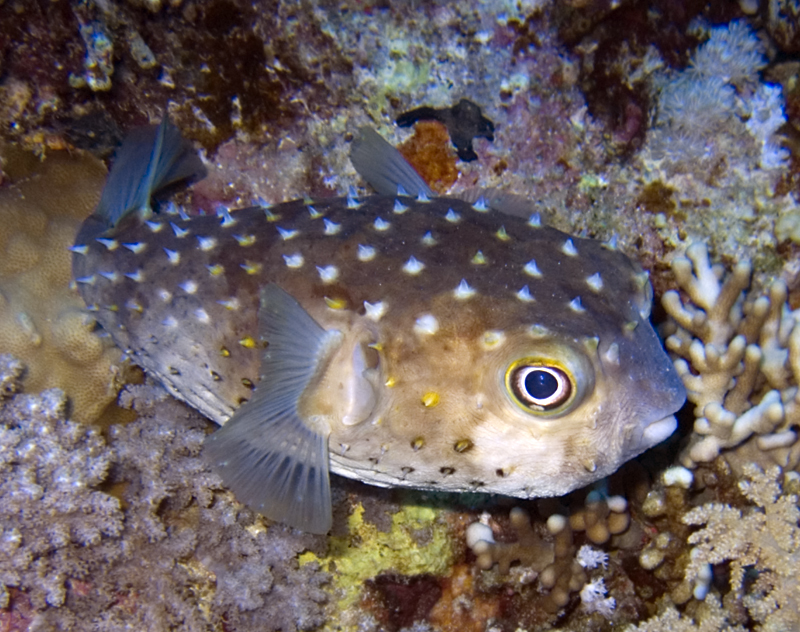 WorldPorcupinefish
Spiny marine fish that inflate into a defensive sphere to deter predators.Other · Coasts and shelves
 WorldOriental sweetlips
Striped reef fish with swollen lips found in the Indo-Pacific.Other · Coasts and shelves · 1758
