
Marble trout
Adriatic freshwater salmonid with marbled skin
The marble trout is a large freshwater fish native to Adriatic rivers in Italy, Slovenia, Croatia, Bosnia and Herzegovina, and Montenegro. It features a unique marbled pattern and faces threats from dams, pollution, and hybridisation with stocked trout.
- Distinctive marbled colour pattern varies with surroundings
- Can grow up to 120 cm and weigh over 22 kg
- Native to Adriatic basin rivers in five countries
- Threatened by dams, pollution and hybridisation
- Reintroduction programme uses pure Soča basin stocks
What it is
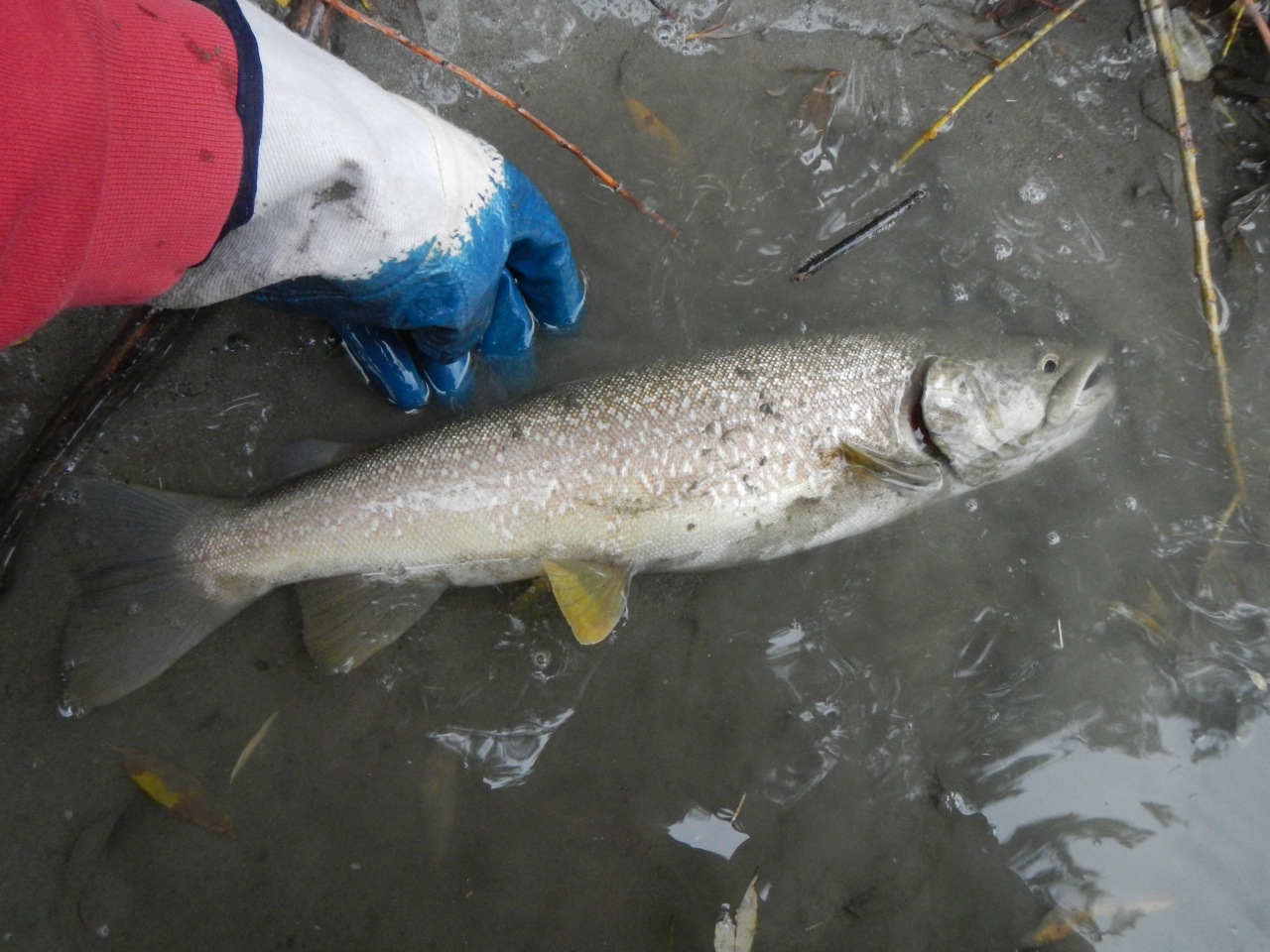
This species belongs to the salmon family and lives in fresh water. It has a long, cylindrical body that is slightly flattened on the sides. The head is large, making up nearly a quarter of its total length. This feature gives it the local name glavatica, which means head. Its most striking trait is a marbled colour pattern that changes intensity based on the surroundings. Some individuals show red spots along the lateral line, a sensory organ running down the side. Adults usually measure between 30 and 70 centimetres.
Where it lives
The fish inhabits specific drainages within the Adriatic basin. In Italy, it lives in tributaries of the Po River and direct Adriatic watersheds like the Adige and Piave. It shares populations in the Soča river with Slovenia and the Neretva river with Croatia and Bosnia and Herzegovina. It also occurs in the Morača and Zeta rivers in Montenegro. The species is likely extinct in Albania and Greece, where it once lived in the Drin and Aoos basins. An anadromous form may exist in the Eastern Adriatic Sea.
How it lives
Marble trout are predators that feed mainly on smaller fish and bottom-dwelling invertebrates. They prefer rivers where the water temperature stays near 15 degrees Celsius in summer. The species can grow very large, with reports of individuals reaching 30 kilograms. The biggest confirmed specimens come from the Neretva River canyon in Bosnia and Herzegovina. A commercial catch off the coast of Igrane suggests some may adapt to salty sea water, though this form is rare.
Breeding and life cycle
Males become sexually mature after three years, while females take four years. Spawning takes place during November and December. Pure genetic populations were identified in remote streams of the Soča basin. This effort aims to restore numbers in areas where the fish has declined due to human activity.
Fish and people
Anglers value this fish for sport fishing due to its large size. It is also taken for food, though poaching remains a problem in some regions. The construction of dams, such as the Jablanica Dam on the Neretva, has altered its habitat significantly. Local communities in Bosnia refer to it as glavatica. Conservation efforts focus on protecting pure strains from mixing with non-native trout stocked for fishing.
Status and threats
The species faces multiple threats across its range. Hybridisation with foreign trout species introduced for angling dilutes the gene pool. Water extraction and pollution degrade its river habitats. In Bosnia and Herzegovina, dam construction and plans for new barriers on the upper Neretva cause habitat loss. Overfishing and poaching further reduce populations. Only eight genetically pure populations remain in the wild.



Questions people ask about Marble trout
What does the marble trout look like?
It has a long, cylindrical body with a large head and a distinctive marbled colour pattern. The intensity of the colour changes with the environment, and some have red spots along the lateral line.
Where can you find marble trout?
They live in freshwater rivers of the Adriatic basin in Italy, Slovenia, Croatia, Bosnia and Herzegovina, and Montenegro. They are likely extinct in Albania and Greece.
Why is the marble trout threatened?
Major threats include hybridisation with stocked trout, water pollution, and habitat loss from dam construction. Overfishing and poaching also contribute to population declines in several regions.
Good reading and sources
- Salmo marmoratus on WikipediaEncyclopedia
- More photos on Wikimedia CommonsPhotos
- Wikidata recordOpen data
The facts on this page come from the Wikipedia article "Salmo marmoratus", written by its contributors and used under the CC BY-SA 4.0 licence, and from its Wikidata record (CC0). EveryFish rewrote the text in its own words, with AI assistance, and compares every page with the article to make sure no passage is copied. It may be reused under the same CC BY-SA 4.0 licence with a link back.
It may contain mistakes, and figures change over time. Nothing here is investment or buying advice. If something is wrong, tell us. Last refreshed 2026-11-15.
Like Marble trout
All salmon and trout 🇬🇧 United Kingdom and 3 moreSea trout
Anadromous form of brown trout that migrates between sea and rivers.Salmonid · Between sea and river
 🇺🇸 United States and 4 moreOncorhynchus
A genus of migratory fish native to the North Pacific basin.Salmonid · Rivers and lakes
 WorldBrown trout
A widespread salmonid with river, lake and sea forms.Salmonid · Rivers and lakes · 1758
 🇺🇸 United States and 3 moreDolly Varden trout
A cold-water char native to the North Pacific rim.Salmonid · Rivers and lakes · 1792
More from Salmonidae
All of them WorldTaimen
Large freshwater salmonids native to EurasiaSalmonid · Rivers and lakes
 🇺🇸 United StatesApache trout
A golden-spotted trout native to Arizona highlands.Salmonid · Rivers and lakes
 🇺🇸 United StatesCisco
Small salmonid fish of northern lakes and seasSalmonid · Rivers and lakes
 🇬🇧 United KingdomSchelly
Rare whitefish of the English Lake DistrictSalmonid · Rivers and lakes