
Sailfish
Fastest marine fish with a large dorsal fin.
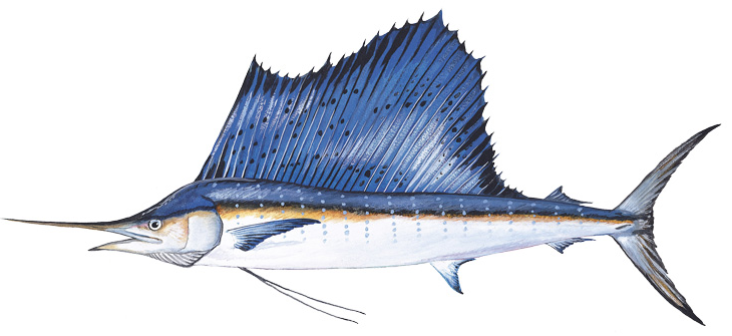
The sailfish is a billfish known for its speed and distinctive sail-like dorsal fin. It inhabits tropical and temperate oceans, hunting schooling fish with its elongated bill. Recent studies suggest it is slower than previously thought but remains a top predator.
- Holds record for highest speed of any marine animal
- Uses bill to injure prey in schooling fish
- Can change colour to confuse prey or communicate
- Hunts in groups using proto-cooperation strategies
- Dorsal fin reduces head oscillation during attacks
What it is
The sailfish is a marine billfish in the genus Istiophorus. It features a long, pointed bill and a prominent dorsal fin that runs along most of its back. This fin resembles a sail when raised. The body is typically blue to gray. Adults usually reach lengths of up to three metres and weigh less than ninety kilograms. They are built for speed in open water.
Where it lives
These fish live in tropical and temperate waters across the globe. They are common in the Pacific and Indian Oceans. Sailfish prefer epipelagic zones near continental coasts, islands, and coral reefs. In some regions, they depend on reefs for feeding and breeding. Loss of reef habitats can lead to local population declines, as seen in the Persian Gulf.
How it lives
Sailfish hunt smaller fish and squid near the surface or at mid-depths. They use their bills to slash or tap at schooling prey, injuring them to slow them down. Attacks often target the rear of a school where injured fish lag. They may hunt in groups, benefiting from the efforts of others without coordinated planning. This behaviour is called proto-cooperation. Individuals often show a preference for striking to the left or right.
Fish and people
Sailfish are prized in sport fishing circles alongside marlins and swordfish. They are renowned for their speed and fighting ability. There are rare reports of sailfish attacking humans in self-defence when caught. One incident involved a fish stabbing a person with its bill. They are not typically harvested for food on a large commercial scale compared to other species.
Status and threats
Taxonomic debates exist regarding whether one or two species exist. Most authorities now recognise a single species, Istiophorus platypterus. FishBase still lists two: the Atlantic and Indo-Pacific sailfish. Genetic and physical studies show little difference between the proposed groups. Conservation threats include habitat loss, particularly the degradation of coral reefs.


Questions people ask about Sailfish
How fast can a sailfish swim?
Earlier estimates suggested speeds up to 125 km/h. Recent research indicates they do not exceed 35 to 55 km/h. Burst speeds during hunting are around 25 km/h. They remain among the fastest marine animals despite lower recorded speeds.
Why do sailfish raise their dorsal fin?
The sail is usually folded down while swimming. It is raised during attacks to reduce sideways head oscillations. This makes the bill less detectable to prey, allowing the fish to strike without being noticed until the last moment.
Do sailfish hunt alone or in groups?
They often attack individually but benefit from group presence. This proto-cooperation allows them to injure more prey, making capture easier. Groups of up to seventy individuals may gain advantages from this uncoordinated collective hunting strategy.
Good reading and sources
The facts on this page come from the Wikipedia article "Sailfish", written by its contributors and used under the CC BY-SA 4.0 licence, and from its Wikidata record (CC0). EveryFish rewrote the text in its own words, with AI assistance, and compares every page with the article to make sure no passage is copied. It may be reused under the same CC BY-SA 4.0 licence with a link back.
It may contain mistakes, and figures change over time. Nothing here is investment or buying advice. If something is wrong, tell us. Last refreshed 2026-11-15.
Like Sailfish
All other fish WorldGreat barracuda
Large predatory fish found in warm oceans worldwide.Other · Coasts and shelves
 WorldBlue-spotted grouper
A widely distributed Indo-Pacific grouper known for its blue spots and invasive impact in Hawaii.Other · Coasts and shelves
 WorldYellowstripe goatfish
A small Indo-Pacific reef fish with yellow fins and shrimp-like taste.Other · Coasts and shelves
 WorldStriped marlin
Fast pelagic predator with blue stripesOther · Open ocean