
Indian glassy fish
Small transparent freshwater fish popular in home aquariums
This tiny ray-finned fish from South Asia features a clear body that reveals its skeleton. It thrives in still fresh waters and is a staple of the global aquarium trade, though often subjected to harmful dyeing practices.
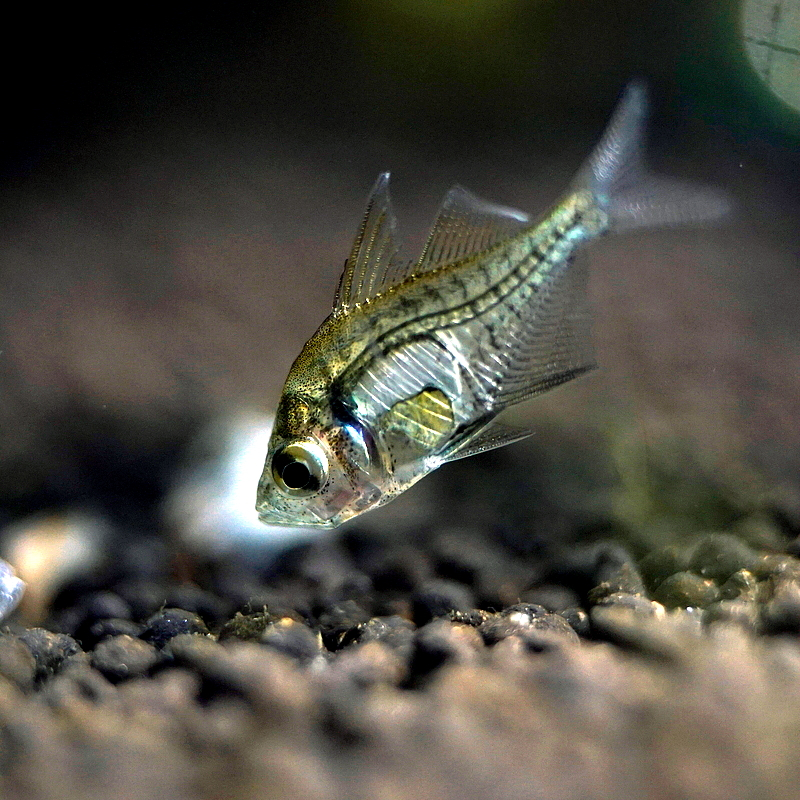
- Body is transparent enough to see internal organs
- Grows to a maximum length of 80 mm
- Often dyed artificially for the aquarium trade
- Prefers standing freshwater habitats
- Lifespan of three to four years in captivity
What it is
The Indian glassy fish is a small member of the Asiatic glassfish family. Its most striking feature is a completely transparent body, which allows observers to see internal organs and bones clearly. Males develop a dark rim on their dorsal fin as they mature. These fish remain quite small, reaching a maximum length of only 80 mm. They are ray-finned creatures native to various parts of South and Southeast Asia.
Where it lives
This species inhabits a broad geographic area stretching from Pakistan across to Vietnam, including Malaysia and Bangladesh. It prefers standing bodies of water such as ponds and impoundments rather than fast-flowing rivers. In captivity, it adapts well to slightly soft or moderately hard water with a neutral pH balance. The fish tolerates temperatures between 20 and 30 degrees Celsius, making it suitable for many tropical tank setups.
How it lives
In the wild, these fish feed on small invertebrates including worms and crustaceans. They occupy the middle and lower sections of their environment. Larger predators, such as snakeheads, hunt them for food. Aquarium specimens prefer live or frozen foods over dried flakes. They are generally peaceful but can be delicate if water conditions are not maintained properly.
Breeding and life cycle
Spawning activity increases significantly during the rainy season. The reproductive process involves females releasing eggs into the water column. Males then swim through to fertilize these eggs externally. This prolific breeding strategy helps maintain population numbers in their natural habitat despite high predation pressure from larger fish species.
Fish and people
While not consumed as food by humans, this fish is extremely popular in the aquarium hobby. Unfortunately, many specimens sold are injected with artificial dye to create bright colours, a practice known as painting. This procedure causes kidney damage and stress, leading to shorter lifespans and disease susceptibility. Healthy, undyed individuals can live for three to four years if cared for correctly.
Questions people ask about Indian glassy fish
Why do some Indian glassy fish have bright colours?
These colours are usually artificial. Sellers inject dye into the transparent tissue to make the fish more attractive. This process is harmful and causes health issues like kidney damage and disease.
What water conditions do they need in an aquarium?
They thrive in freshwater with a pH between 6.5 and 7.5. The water hardness should be moderate, and temperatures must stay between 20 and 30 degrees Celsius for optimal health.
Do they eat flake food?
Generally no. They prefer small live or frozen foods such as crustaceans and worms. Dried flakes are often ignored, so hobbyists should provide appropriate meaty options.
Good reading and sources
- Parambassis ranga on WikipediaEncyclopedia
- More photos on Wikimedia CommonsPhotos
- Wikidata recordOpen data
The facts on this page come from the Wikipedia article "Parambassis ranga", written by its contributors and used under the CC BY-SA 4.0 licence, and from its Wikidata record (CC0). EveryFish rewrote the text in its own words, with AI assistance, and compares every page with the article to make sure no passage is copied. It may be reused under the same CC BY-SA 4.0 licence with a link back.
It may contain mistakes, and figures change over time. Nothing here is investment or buying advice. If something is wrong, tell us. Last refreshed 2026-11-15.
Like Indian glassy fish
All perches, basses and snappers 🇮🇳 India and 4 moreBlue perch
Small Asian freshwater fish with blue finsPerch-like · Rivers and lakes
 🇺🇸 United States and 2 moreGreen sunfish
A small, aggressive freshwater fish native to North America, known for its blue-green colour and invasive potential in nPerch-like · Rivers and lakes
 OceaniaBanded archerfish
A silvery fish that spits water jets to catch prey.Perch-like · Estuaries and mangroves · 1767
🇧🇩 Bangladesh and 4 moreBanded gourami
Small tropical air-breathing fish with striped patternsPerch-like · Rivers and lakes · 1801
