
Neon tetra
A small, brightly coloured freshwater fish popular in home aquariums.
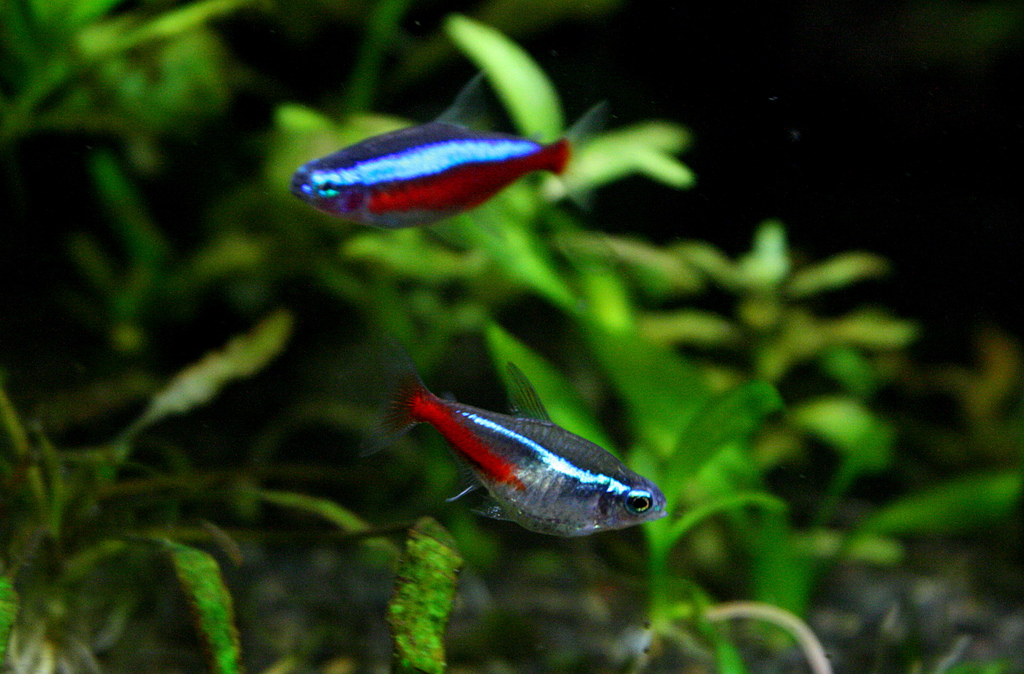
The neon tetra is a tiny South American characin known for its vivid blue and red stripes. It is one of the most widely kept tropical fish globally, primarily bred in Southeast Asia for the aquarium trade.
- Adults grow to approximately 4 cm in length.
- Iridescent stripes change color based on lighting conditions.
- Over 1.5 million specimens are imported to America monthly.
- Native to acidic blackwater streams in the Amazon basin.
- Susceptible to incurable neon tetra disease caused by parasites.
What it is
This species belongs to the order Characiformes and the family Acestrorhamphidae. Adults reach roughly four centimetres in length. The body features a silver-white belly and a light-blue back. A bright iridescent blue stripe runs horizontally from the nose to the adipose fin. A second iridescent red stripe starts at the mid-body and extends to the tail base. The skin and fins are partially transparent. These markings shift to gray or black at night due to guanine crystals reflecting less light. Males display a straighter blue line, while females have a rounder belly that bends the stripe.
Where it lives
Native waters span southeastern Colombia, eastern Peru, and western Brazil within the Amazon basin. The fish inhabits acidic blackwater and transparent clearwater streams. It avoids whitewater rivers. Preferred conditions include temperatures between 20 and 28 degrees Celsius and pH levels from 4 to 7.5. The United Nations Food and Agriculture Organization lists the species as introduced in Singapore and the United States. It remains unestablished in Singapore despite being considered beneficial there.
How it lives
These fish form shoals and require groups of at least six individuals to remain active. They thrive best in densely planted tanks mimicking their native environment. As omnivores, they consume flake foods, brine shrimp, daphnia, and freeze-dried bloodworms. Tropical sinking pellets with color enhancers support their vibrant hues. Predators in the wild likely include larger fish and birds. In captivity, they face risks from neon tetra disease, caused by the parasite Pleistophora hyphessobryconis. This condition causes restlessness, cysts, and spinal curvature. False neon disease presents similar symptoms but is bacterial.
Breeding and life cycle
Reproduction requires specific water parameters including dim lighting, low hardness, a pH near 5.5, and high tannin content. Temperatures should sit around 24 degrees Celsius. Fish reach sexual maturity at twelve weeks. Breeding is difficult in home aquaria but common in commercial farms. Less than five percent of specimens sold in America are wild-caught. Over 1.5 million specimens are imported monthly from farms. Captive breeding on a large scale does not exist in the USA outside experimental efforts.
Fish and people
The species was described by ichthyologist George S. Myers in 1936 and named for William T. Innes. It ranks among the most popular tropical fish worldwide. Approximately two million units sell monthly in the United States. Most supply comes from Southeast Asian farms, with minor imports from Colombia, Peru, and Brazil. Ideal aquarium conditions involve pH 6.0 to 7.0, temperature 22–24 degrees Celsius, and low nitrate levels. Lifespans typically last two to three years in tanks, though wild individuals may live up to ten years.
Status and threats
The International Union for Conservation of Nature does not list a specific threat level in the provided data. The species remains abundant in its native range. Commercial farming has reduced reliance on wild collection. Disease prevention is critical for hobbyists. Quarantining new arrivals helps stop parasite spread. Removal of infected fish preserves the school. Good water quality and preventive measures keep the disease rare.


Questions people ask about Neon tetra
What does a neon tetra eat?
They are omnivores that accept small flake foods. Supplement their diet with brine shrimp, daphnia, freeze-dried bloodworms, tubifex, and micropellets. Tropical sinking pellets often contain natural color enhancers.
How do I tell male from female neon tetras?
Males are slender with a straight blue stripe. Females are rounder with a bent blue line. Plumpness may also indicate eggs or overeating rather than gender.
What water conditions do they need in an aquarium?
Maintain a temperature of 22–24°C and pH between 6.0 and 7.0. Keep general hardness below 10 dGH and nitrates under 20 ppm. Use a tank of at least 10 gallons with dense planting.
Is neon tetra disease fatal?
Yes, it is generally incurable and often fatal. Caused by the parasite Pleistophora hyphessobryconis, it leads to cysts and spinal curvature. Prevention through quarantine and good water quality is essential.
Good reading and sources
The facts on this page come from the Wikipedia article "Neon tetra", written by its contributors and used under the CC BY-SA 4.0 licence, and from its Wikidata record (CC0). EveryFish rewrote the text in its own words, with AI assistance, and compares every page with the article to make sure no passage is copied. It may be reused under the same CC BY-SA 4.0 licence with a link back.
It may contain mistakes, and figures change over time. Nothing here is investment or buying advice. If something is wrong, tell us. Last refreshed 2026-11-15.
Like Neon tetra
All other fish 🇧🇷 Brazil and 2 moreCardinal tetra
Small freshwater fish with a bright red belly and iridescent blue stripe.Other · Rivers and lakes · 1956
 🇨🇩 Democratic Republic of the CongoCongo tetra
A colourful African freshwater fish kept in home aquaria for its bright scales and feathery tail.Other · Rivers and lakes · 1899
 🇧🇷 Brazil and 1 moreX-ray tetra
Small translucent South American freshwater fish popular in home aquariums.Other · Rivers and lakes · 1894
 🇧🇷 Brazil and 4 moreMarbled hatchetfish
A small South American freshwater fish kept in aquariums for its unique shape and surface-dwelling habits.Other · Rivers and lakes · 1864
More from Acestrorhamphidae
All of them 🇧🇷 BrazilRummy-nose tetra
Small Amazonian characin with a red head and striped tail.Other · Rivers and lakes · 1924
 🇻🇪 VenezuelaDiamond tetra
Small Venezuelan freshwater fish with violet finsOther · Rivers and lakes · 1920
 🇵🇾 Paraguay and 3 moreBuenos Aires tetra
Hardy silver freshwater fish with red fins and a black tail mark.Other · Rivers and lakes · 1907