
Malabar danio
A small, striped freshwater fish from India and Sri Lanka.
The Malabar danio is a tropical freshwater fish native to southern India and Sri Lanka. It lives in streams and pools, growing up to 15 cm. Popular in aquariums, it is listed as Least Concern by the IUCN despite local threats.
- Grows up to 15 cm in the wild
- Releases chemical alarm signal when injured
- Spawns after heavy rains in shallow water
- Listed as Least Concern by IUCN
- Captive bred in Singapore and Thailand
What it is
This ray-finned fish has a streamlined, laterally compressed body with a forked tail. Its colour features orange longitudinal stripes on the flanks, often broken by irregular vertical bars near the head. The mouth faces upwards, and the dorsal fin sits towards the rear. A distinctive notch in the lower jaw helps identify it as part of the Danionidae family. Males develop small bumps on their front fin rays, while both sexes lack breeding tubercles elsewhere. It grows larger than many relatives, reaching 15 cm in the wild.
Where it lives
Native to the lowlands of Sri Lanka and the west coast of India, this species thrives in diverse waters. It inhabits mountain torrents, hill streams, and quiet pools up to 1,300 metres above sea level. The fish tolerates varying water clarity and shade, living in both dry and wet climatic zones. It prefers temperatures between 18 and 25 degrees Celsius. This adaptability allows it to occupy both flowing and still water ecosystems across its geographic range.
How it lives
Active and social, these fish form medium-sized shoals near the surface. They feed on terrestrial insects, plant debris, and detritus. Warmer water helps them locate food more efficiently, though it does not significantly increase their swimming speed. When injured, they release a chemical signal that warns nearby schoolmates to flee rapidly. This alarm response is common among similar cypriniform fish. Their generalist nature supports unrestricted gene flow across their wide distribution.
Breeding and life cycle
Spawning occurs in shallow water among bottom plants, typically after heavy rains. Females release around 200 sticky, light-orange eggs during each event. The eggs hatch within one or two days, and the young become free-swimming by the fifth day. Adults provide no care for the offspring and may consume the eggs if left in the tank. Removing parents after spawning improves survival rates. Males mature at 5 cm, while females mature slightly smaller at 4 cm.
Fish and people
Aquarists value this species for its bright colours and active behaviour. It is widely circulated in the global aquarium trade. To reduce pressure on wild populations, captive breeding programmes operate in Singapore, Thailand, and Hong Kong. In its native range, it faces threats from agricultural pollution, dam construction, and habitat alteration. Despite these challenges, it remains a common sight in local waters and is not currently considered threatened.
Status and threats
The International Union for Conservation of Nature lists the species as Least Concern. Assessments in 2009, 2011, and 2019 indicate a stable overall population. However, local threats persist, including indiscriminate fishing, invasive species, and climate change. Habitat modification through dams and pollution also poses risks. The availability of captive-bred specimens for the aquarium trade helps mitigate exploitation of wild stocks.
Questions people ask about Malabar danio
How big does the Malabar danio get?
In the wild, this fish can reach a maximum length of 15 cm. However, in home aquariums, it rarely exceeds 10 cm. It is considered relatively large compared to many other species in its family.
What do Malabar danios eat?
They are omnivores that feed on terrestrial insects, plant matter, and detritus. In the wild, they forage near the water surface. Warmer temperatures help them find food more easily.
Do they care for their young?
No, they do not exhibit parental care. In fact, adults may eat their own eggs. Breeders often remove the parents after spawning to protect the sticky eggs and ensure higher survival rates for the fry.
Where are they found in the wild?
They are native to southern India and Sri Lanka. They live in a variety of freshwater habitats, including mountain streams, hill torrents, and lowland flood plains, up to 1,300 metres above sea level.
Good reading and sources
- Malabar danio on WikipediaEncyclopedia
- More photos on Wikimedia CommonsPhotos
- Wikidata recordOpen data
The facts on this page come from the Wikipedia article "Malabar danio", written by its contributors and used under the CC BY-SA 4.0 licence, and from its Wikidata record (CC0). EveryFish rewrote the text in its own words, with AI assistance, and compares every page with the article to make sure no passage is copied. It may be reused under the same CC BY-SA 4.0 licence with a link back.
It may contain mistakes, and figures change over time. Nothing here is investment or buying advice. If something is wrong, tell us. Last refreshed 2026-11-15.
Like Malabar danio
All other fish 🇮🇩 IndonesiaKuhli loach
A slender, nocturnal freshwater fish from Southeast Asia popular in aquariums.Other · Rivers and lakes · 1846
 🇧🇼 Botswana and 1 moreAfrican tigerfish
Predatory freshwater fish known for sharp teeth and leaping hunting behaviour.Other · Rivers and lakes · 1861
 🇧🇷 Brazil and 4 moreMarbled hatchetfish
A small South American freshwater fish kept in aquariums for its unique shape and surface-dwelling habits.Other · Rivers and lakes · 1864
 🇧🇷 Brazil and 1 moreX-ray tetra
Small translucent South American freshwater fish popular in home aquariums.Other · Rivers and lakes · 1894
More from Danionidae
All of them WorldDanio
A genus of small striped freshwater fish from Asia kept in aquaria.Other · Rivers and lakes · 1822
 WorldRasbora
A diverse genus of small freshwater fish native to South and Southeast Asia.Carp · Rivers and lakes · 1822
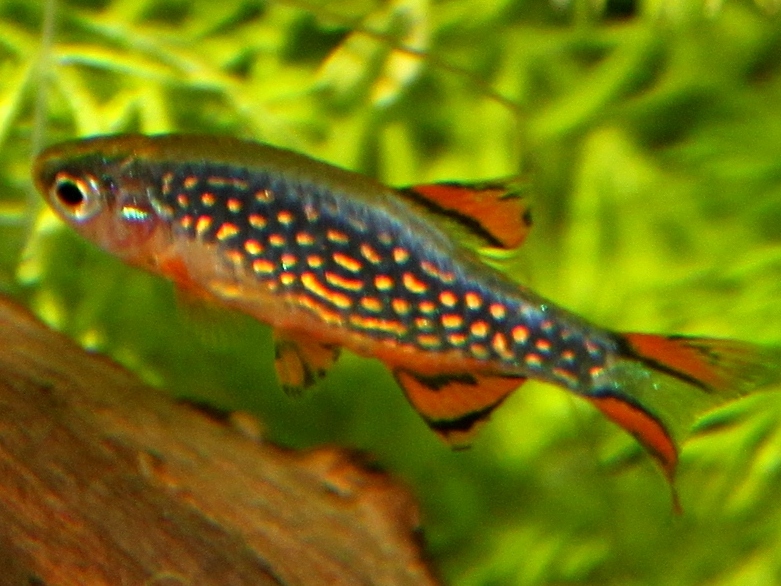 🇲🇲 Myanmar and 1 moreCelestial pearl danio
A tiny, brightly coloured freshwater fish from Myanmar and Thailand, popular in the aquarium trade.Carp · Rivers and lakes · 2006
 🇺🇬 Uganda and 2 moreSilver cyprinid
A small pelagic fish from Lake Victoria that supports regional food security.Other · Rivers and lakes