
European angler
A bottom-dwelling Atlantic fish with a lure-tipped spine.
The European angler is a large-headed marine fish found in the northeast Atlantic and Mediterranean. It uses a modified dorsal spine as a lure to attract prey on sandy seabeds. This species supports significant commercial fisheries in regions like the Irish Sea and Iberian waters.
- Uses a dorsal spine as a lure to attract prey
- Releases gelatinous egg sheets containing millions of eggs
- Can swallow prey as large as itself
- Lives on sandy bottoms up to 1,000 metres deep
- Supports major commercial fisheries in Europe
What it is
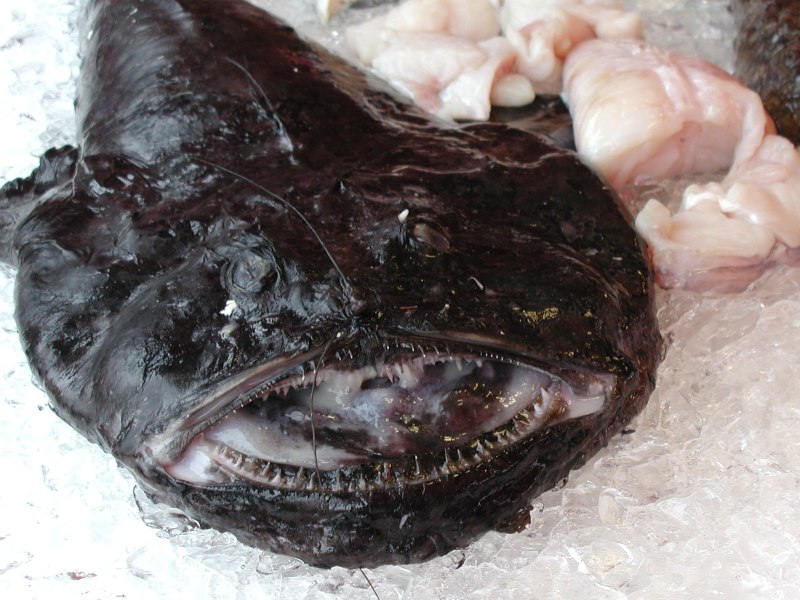
This fish features a broad, flat head that dominates its body shape. Its wide mouth circles the front of the head and contains inward-pointing teeth designed to trap prey. The skin lacks scales but has fringed appendages that mimic seaweed for camouflage. It can change colour to match the seabed. The first three spines of the dorsal fin are detached and modified into tentacle-like structures. The longest spine acts as a fishing rod, tipped with a fleshy lure called an esca.
Where it lives
It inhabits coastal and shelf waters across the northeast Atlantic. The range extends from the Barents Sea in the north down to the Strait of Gibraltar. Populations also exist in the Mediterranean and Black Seas. These fish prefer muddy or sandy bottoms but occasionally settle on rocky substrates. They live at depths reaching 1,000 metres but rarely venture below the continental slope. Body size tends to increase with depth, so deeper populations are generally larger.
How it lives
Adults feed mainly on other fish, while juveniles target marine invertebrates. Common prey includes Norway pout in northern waters and blue whiting in the south. In the Irish Sea, they consume whiting and Norway lobster. Cephalopods are a key food source in the Cantabrian Sea. The fish uses its lure to attract victims within reach of its jaws. It can swallow prey equal to its own size due to an expandable stomach. There are records of it capturing waterbirds like herring gulls at the surface.
Breeding and life cycle
Spawning peaks in spring between February and June, with a secondary season in late autumn. Females release vast numbers of eggs, ranging from 300,000 to 2.8 million per event. These eggs are embedded in a transparent, gelatinous sheet that floats near the surface. Wind and currents help disperse the buoyant mass. Larvae are free-swimming and have elongated pelvic fins. Males reach maturity at four years old, while females take two years longer to mature.
Fish and people
Historically, this species was considered valuable bycatch in Atlantic fisheries. Advances in deep-water fishing technology led to a significant rise in captures. It has been an important resource in Iberian waters since the 1980s. The fish supports commercial operations in areas such as the Irish Sea. It is often caught alongside the related blackbellied angler, though this species is more abundant. Its unique appearance and feeding mechanism have long fascinated observers.


Questions people ask about European angler
How does the European angler catch its food?
It uses a modified dorsal spine that acts like a fishing rod. The tip has a fleshy lure which wiggles to attract curious fish. When prey comes close, the angler snaps its huge jaws shut automatically.
Where can you find this fish?
It lives in the northeast Atlantic Ocean, from the Barents Sea to Gibraltar. It is also found in the Mediterranean and Black Seas. It prefers muddy or sandy seabeds at depths up to 1,000 metres.
Is the European angler good to eat?
Yes, it supports important commercial fisheries. Catches increased with better deep-water technology. It has been a key resource in Iberian waters since the 1980s and is valued in markets across Europe.
What do the eggs look like?
The female releases a thin, transparent sheet of gelatinous material. This sheet can be several metres long and contains millions of eggs in individual cavities. It floats near the surface to aid dispersal.
Good reading and sources
- Lophius piscatorius on WikipediaEncyclopedia
- More photos on Wikimedia CommonsPhotos
- Wikidata recordOpen data
The facts on this page come from the Wikipedia article "Lophius piscatorius", written by its contributors and used under the CC BY-SA 4.0 licence, and from its Wikidata record (CC0). EveryFish rewrote the text in its own words, with AI assistance, and compares every page with the article to make sure no passage is copied. It may be reused under the same CC BY-SA 4.0 licence with a link back.
It may contain mistakes, and figures change over time. Nothing here is investment or buying advice. If something is wrong, tell us. Last refreshed 2026-11-15.
Like European angler
All other fish WorldGoatfish
Benthic fish with chin barbels found in tropical and temperate waters worldwide.Other · Coasts and shelves · 1758
 WorldAtlantic wolffish
A cold-water North Atlantic fish with crushing teeth and parental care.Other · Coasts and shelves · 1758
 WorldAnglerfish
Ray-finned fish using a modified dorsal fin ray as a lure to catch prey.Other · Coasts and shelves · 1829
 EuropeRabbit fish
Deep-water cartilaginous fish with a rabbit-like headOther · Coasts and shelves