
Goatfish
Benthic fish with chin barbels found in tropical and temperate waters worldwide.
Goatfish are ray-finned fish belonging to the family Mullidae. They inhabit littoral zones globally, using sensory whiskers to forage on the seabed.
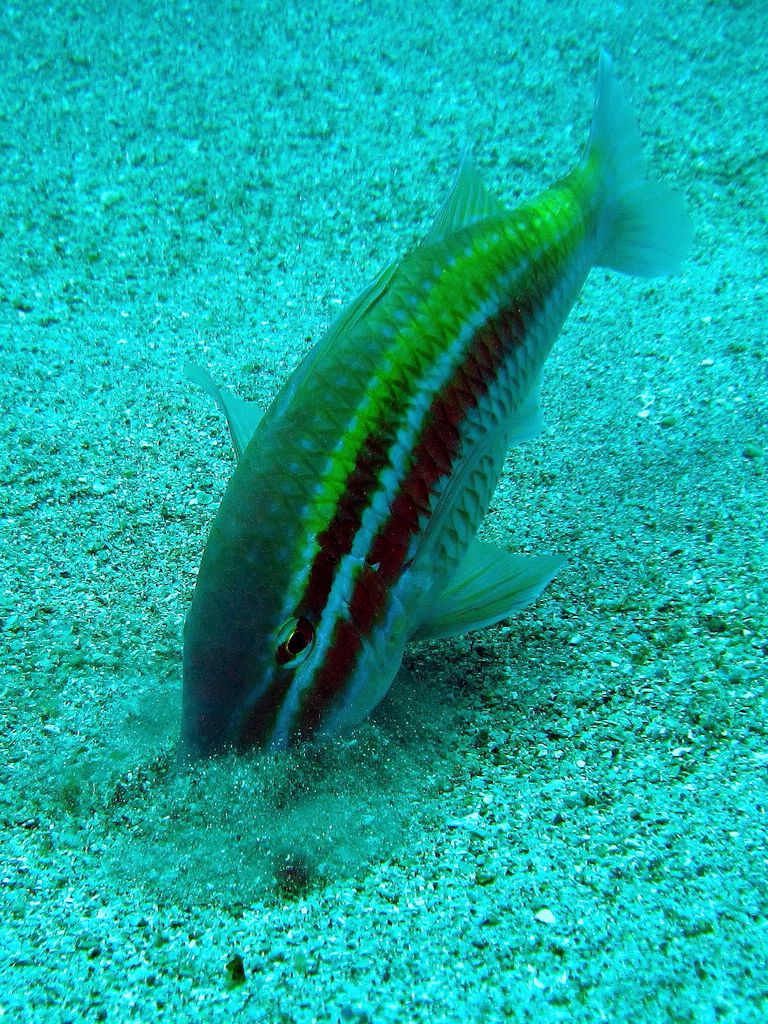
- Chin barbels act as chemosensory organs to find food in sand.
- Largest species, dash-and-dot goatfish, grows to 60 cm.
- Some species hunt cooperatively with moray eels in Indonesia.
- Ancient Romans served live goatfish for their colour-changing ability.
- Eggs float freely in plankton before larvae develop barbels.
What it is
Goatfish belong to the family Mullidae within the order Syngnathiformes. Their bodies are elongated and deep, featuring forked tails and widely separated dorsal fins. The first dorsal fin holds six to eight spines, while the second has one spine and soft rays. A defining trait is the pair of chin barbels containing chemosensory organs. These whiskers help probe sand or reef holes for food. Most species display bright colours, though the largest, the dash-and-dot goatfish, reaches sixty centimetres. Many genera exist, including Mulloidichthys and Parupeneus.
Where it lives
These fish live in tropical, subtropical, and temperate waters across the globe. They typically inhabit the bottom of shallow littoral zones. Some species associate closely with coral reefs. Others venture into estuaries and rivers, such as the freckled goatfish. Certain deep-water species like Upeneus davidaromi dwell at depths of five hundred metres. This wide distribution allows them to occupy diverse marine environments from shallow coasts to deeper shelves.
How it lives
Goatfish feed on the seabed, searching for worms, crustaceans, and molluscs using their sensory barbels. Other fish often follow them to catch overlooked prey, a behaviour called shadow feeding. Large schools form during the day when they are inactive. These groups may mix different species, such as yellowfin goatfish joining bluestripe snappers. All goatfish can rapidly alter their colour based on activity levels. For instance, the goldsaddle goatfish shifts from lemon-yellow to pale cream while hunting.
Breeding and life cycle
They spawn by releasing buoyant eggs into the water column. These eggs drift as part of the plankton until hatching occurs. Larvae remain in oceanic waters or outer shelves for four to eight weeks. During this time, they develop barbels before adopting a bottom-feeding lifestyle. Juveniles often prefer soft bottoms in seagrass beds or mangroves. As they grow, they shift habitats and social behaviours. Most species reach reproductive maturity within one to two years.
Fish and people
Goatfish support important fisheries worldwide. Historically, ancient Romans valued specific species for aesthetic reasons rather than taste. They served these fish alive so guests could watch them change colour upon death. This practice continued until the end of the second century BCE. Today, they remain economically significant in many regions. Their unique biology and role in coastal ecosystems continue to attract scientific interest.



Questions people ask about Goatfish
What are the whiskers on a goatfish used for?
The chin barbels contain chemosensory organs. They allow the fish to probe sand or reef holes to locate worms, crustaceans, and other small invertebrates hidden in the sediment.
Do goatfish change colour?
Yes, all goatfish can rapidly alter their colour depending on their activity. Some species adopt pale colours to blend with sand when resting. Others shift shades while hunting or interacting with other fish.
Where do goatfish live?
They inhabit tropical, subtropical, and temperate waters worldwide. Most stay near the bottom of shallow littoral zones. Some species enter estuaries, while others dwell at depths of up to five hundred metres.
How do goatfish reproduce?
They are pelagic spawners that release buoyant eggs into the water. The eggs drift with currents as plankton. Larvae develop barbels after four to eight weeks before settling to the bottom to feed.
Good reading and sources
The facts on this page come from the Wikipedia article "Goatfish", written by its contributors and used under the CC BY-SA 4.0 licence, and from its Wikidata record (CC0). EveryFish rewrote the text in its own words, with AI assistance, and compares every page with the article to make sure no passage is copied. It may be reused under the same CC BY-SA 4.0 licence with a link back.
It may contain mistakes, and figures change over time. Nothing here is investment or buying advice. If something is wrong, tell us. Last refreshed 2026-11-15.
Like Goatfish
All other fish 🇮🇳 India and 4 moreReef stonefish
A highly venomous marine fish known for its rock-like camouflage and potent toxins.Other · Coasts and shelves · 1801
 WorldBigeye trevally
A large marine fish found in tropical oceans, known for its nocturnal hunting and distinctive dark dorsal fin.Other · Coasts and shelves · 1825
 WorldAnglerfish
Ray-finned fish using a modified dorsal fin ray as a lure to catch prey.Other · Coasts and shelves · 1829
 WorldBlue-spotted grouper
A widely distributed Indo-Pacific grouper known for its blue spots and invasive impact in Hawaii.Other · Coasts and shelves
