Lake whitefish
A cool-water freshwater fish from North America.
The lake whitefish is a freshwater species native to Canada and the northern United States. It supports major commercial fisheries in the Great Lakes and is valued for its mild flavour. Anglers also target it during summer and winter ice fishing seasons.
- Grows up to 79 cm and weighs around 4 pounds on average.
- Spawns at night on gravel shoals from September to January.
- Major commercial fishery in the Great Lakes region.
- Threatened by invasive sea lampreys and Quagga mussels.
What it is
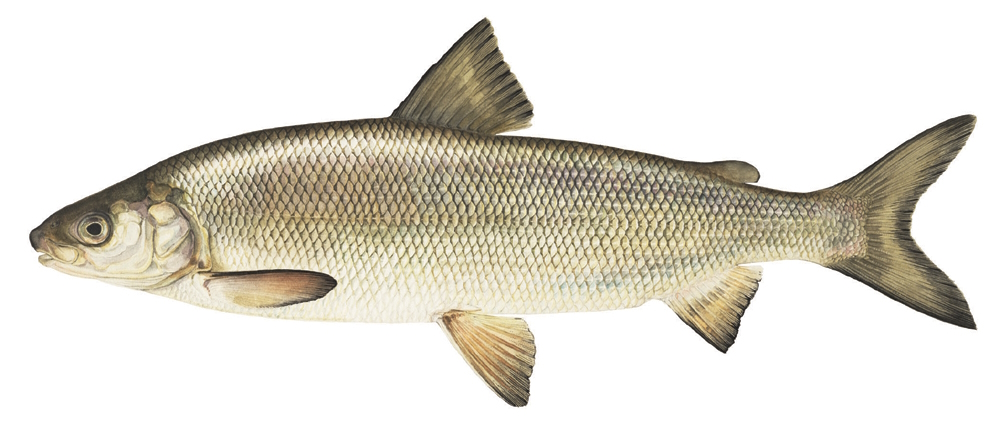
This fish belongs to the salmon family and shares traits like an adipose fin with its relatives. It has a small head relative to its body length, earning it the nickname humpback. The snout overhangs the lower jaw, allowing it to feed near the bottom. Its scales range from silver to white, with olive or brown tones on the back. Ventral fins are white, and the tail features a dark rear edge. Two small flaps sit inside each nostril. Adults typically weigh around four pounds, though some reach five pounds or more.
Where it lives
Its distribution covers Alaska and western Canada east to the Atlantic drainage of Maine and New Brunswick. Populations extend north to Labrador. The species inhabits numerous inland lakes and occasionally enters brackish environments. It thrives in cool waters across this broad northern range. The Great Lakes hold significant populations, particularly in the upper lakes. This wide geographic spread allows it to occupy diverse aquatic habitats within North America.
How it lives
Larvae feed on plankton until they reach three to four inches in length. Adults then switch to bottom-dwelling prey such as snails, insect larvae, and clams. In late summer, some groups rise to feast on emerging mayflies and midges. Natural enemies include burbot, lake trout, and northern pike. Young fish are indistinguishable from cisco by appearance alone, requiring genetic tests for identification. Predators hunt them in both deep and shallow zones depending on the season.
Breeding and life cycle
Spawning occurs between September and January during nighttime hours. Mature fish move into shallow areas to lay eggs on rubble and gravel shoals. Water depth at these sites ranges from two to four metres. No parental care follows egg deposition. The young hatch the following spring. In northwestern regions, large migrations enter deltas like the Athabasca in late summer. Tagged individuals have recorded movements of over 200 miles upstream.
Fish and people
It is a prime commercial species in the Great Lakes, prized for its delicate flavour. Annual harvests once averaged eleven million pounds, though recent figures have declined. Fillets are sold smoked, refrigerated, or vacuum-packed in grocery stores. Sport anglers target them in summer using jigs for surface-feeding fish. Winter ice fishing is popular in places like northern Wisconsin. Guides often use jigging spoons tipped with wax worms for successful catches.
Status and threats
Invasive sea lampreys have threatened populations since the 1930s, particularly in Lake Michigan. These parasites likely entered through canal systems like the Erie and Welland Canals. Quagga mussels also pose a risk by filtering out zooplankton, which juvenile fish need for food. Despite these pressures, the species remains a staple of inland fisheries. Conservation efforts focus on managing these invasive threats to maintain healthy stock levels.

Questions people ask about Lake whitefish
What does lake whitefish taste like?
It is described as a delicately flavored fresh fish with high consumer acceptance. The meat is mild and suitable for smoking, refrigerating, or vacuum-packing for sale in grocery stores and restaurants.
How do you catch lake whitefish?
Anglers use simple line and jig systems in summer when fish feed on mayflies. In winter, ice fishing with jigging spoons and wax worms is a popular and effective method, especially in northern regions.
Where do lake whitefish live?
They inhabit cool inland lakes across Canada and the northern United States, including all Great Lakes. They are found from Alaska to the Atlantic coast and occasionally enter brackish water environments.
Good reading and sources
- Lake whitefish on WikipediaEncyclopedia
- More photos on Wikimedia CommonsPhotos
- Wikidata recordOpen data
The facts on this page come from the Wikipedia article "Lake whitefish", written by its contributors and used under the CC BY-SA 4.0 licence, and from its Wikidata record (CC0). EveryFish rewrote the text in its own words, with AI assistance, and compares every page with the article to make sure no passage is copied. It may be reused under the same CC BY-SA 4.0 licence with a link back.
It may contain mistakes, and figures change over time. Nothing here is investment or buying advice. If something is wrong, tell us. Last refreshed 2026-11-15.
Like Lake whitefish
All salmon and trout 🇬🇧 United Kingdom and 2 moreGrayling
A cold-water salmonid fish native to European rivers, prized by anglers for its distinctive dorsal fin.Salmonid · Rivers and lakes
 🇺🇸 United States and 3 moreDolly Varden trout
A cold-water char native to the North Pacific rim.Salmonid · Rivers and lakes · 1792
 🇺🇸 United StatesApache trout
A golden-spotted trout native to Arizona highlands.Salmonid · Rivers and lakes
 🇷🇺 Russia and 1 moreBaikal black grayling
A Siberian freshwater salmonid found in Lake Baikal and surrounding river systems.Salmonid · Rivers and lakes
More from Salmonidae
All of them 🇬🇧 United KingdomSchelly
Rare whitefish of the English Lake DistrictSalmonid · Rivers and lakes
 🇺🇸 United StatesCisco
Small salmonid fish of northern lakes and seasSalmonid · Rivers and lakes
 WorldTaimen
Large freshwater salmonids native to EurasiaSalmonid · Rivers and lakes
 🇺🇸 United States and 3 moreKokanee salmon
A landlocked freshwater form of the sockeye salmon found in North America and Japan.Salmonid · Rivers and lakes