
Iridescent shark
Large Southeast Asian catfish farmed for food and kept in aquariums.
The iridescent shark is a large freshwater catfish native to the Mekong and Chao Phraya rivers. It is heavily farmed for its mild white meat, sold globally as swai or panga. Juveniles are popular in the aquarium trade due to their shiny appearance, though they require vast space to thrive.
- Adults reach 130 cm in length and 44 kg in weight.
- Juveniles have a shiny iridescence and black stripes.
- Meat is marketed globally as swai, panga or basa.
- Requires minimum 12 m tank size in captivity.
- Migrates upstream during flood seasons to spawn.
What it is
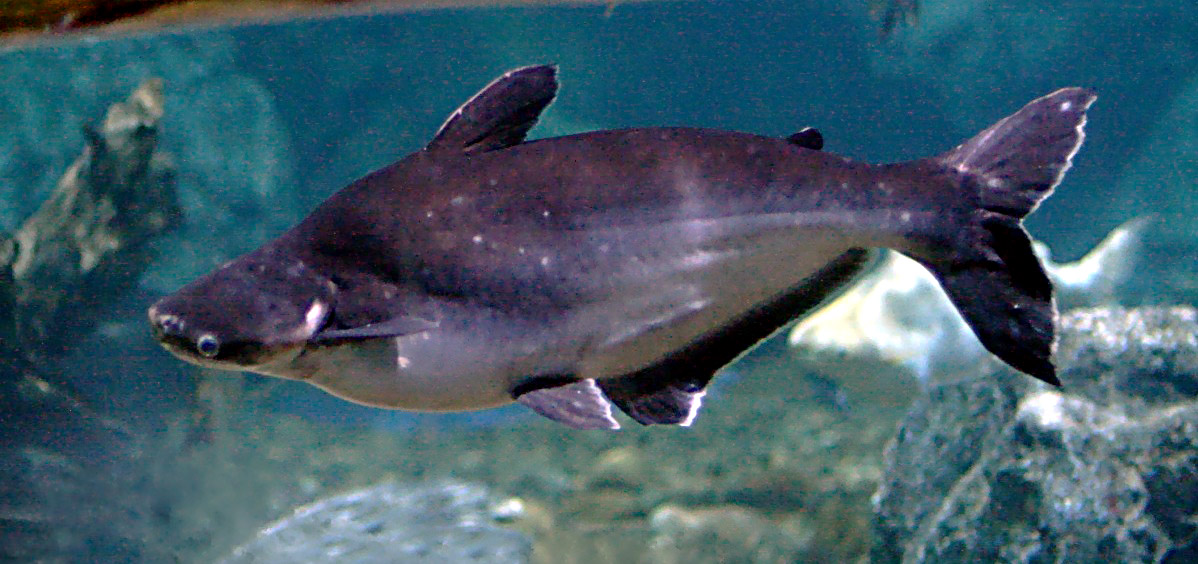
This species is a type of shark catfish, not a true shark. Adults grow up to 130 cm long and weigh 44 kg. They have dark grey or black fins and a uniform grey body when mature. Juveniles display a shiny iridescence and two black stripes along the lateral line. This glow gives the fish its common name. They possess a swim bladder that functions as an air-breathing organ, allowing them to survive in low-oxygen water.
Where it lives
Native to the Mekong and Chao Phraya river systems in Southeast Asia, this fish prefers large, deep tropical waters. It has been introduced to other regions for farming, including parts of Colombia where it was found in the Magdalena River tributaries. It thrives in water with a pH between 6.5 and 7.5 and temperatures from 22 to 26 °C. Introductions have also occurred in Malaysia, Singapore, Indonesia and Myanmar for food production.
How it lives
The iridescent shark is an omnivore that eats crustaceans, other fish and plant material. It lives in large schools, sometimes mixing with spot pangasius and red-tailed tinfoil barb. In Thailand, people often feed these schooling fish near temples as a merit-making activity. The fish has poor eyesight and reacts to movement outside its habitat by fleeing. Stress can cause blind dashes that lead to injury. Physical stressors like turbine blades in hydropower plants also cause high mortality rates.
Breeding and life cycle
This migratory fish moves upstream to spawn during high water levels in the flood season. In the Mekong basin, upstream migration happens from May to July. The fish returns downstream to rearing habitats between September and December as waters recede. South of Khone Falls, migration peaks from November to December, triggered by falling water levels. Migration dates vary across different river systems.
Fish and people
Heavily cultivated for food, its meat is sold as swai, panga, basa or cream dory. Vietnam exported US$1.8 billion worth in 2014. The fillets are cheap, mild and firm. In Malaysia and Indonesia, it is known as ikan patin and cooked with curry or tempoyak. Juveniles are sold for home aquariums but are difficult to keep. They need huge tanks, ideally over 12 metres, to avoid stunted growth and premature death.
Status and threats
Accidental releases from illegal farms have established populations in non-native rivers like the Magdalena in Colombia. This alarms officials because the river hosts many endangered native species. Hydropower developments pose a threat through physical injuries such as blade strikes and turbulence. These stressors increase injury and mortality rates for the migrating populations.

Questions people ask about Iridescent shark
Is the iridescent shark a real shark?
No, it is a species of catfish in the family Pangasiidae. It is called a shark catfish due to its shape and swimming style, but it lacks the biological features of true sharks.
Why is it difficult to keep in home aquariums?
They are active schooling fish that require vast space, ideally tanks over 12 metres long. In small home tanks, their growth becomes stunted, they suffer from stress, and they often die prematurely.
What is swai fish?
Swai is the common market name for the meat of the iridescent shark, particularly in the United States. It is a mild, firm, white fish fillet that is inexpensive and widely exported from Vietnam.
Where does this fish live in the wild?
It is native to the Mekong and Chao Phraya river basins in Southeast Asia. It prefers large, deep tropical freshwater rivers and migrates upstream during flood seasons to spawn.
Good reading and sources
- Iridescent shark on WikipediaEncyclopedia
- More photos on Wikimedia CommonsPhotos
- Wikidata recordOpen data
The facts on this page come from the Wikipedia article "Iridescent shark", written by its contributors and used under the CC BY-SA 4.0 licence, and from its Wikidata record (CC0). EveryFish rewrote the text in its own words, with AI assistance, and compares every page with the article to make sure no passage is copied. It may be reused under the same CC BY-SA 4.0 licence with a link back.
It may contain mistakes, and figures change over time. Nothing here is investment or buying advice. If something is wrong, tell us. Last refreshed 2026-11-15.
Like Iridescent shark
All catfishes 🇧🇷 Brazil and 4 moreTiger shovelnose catfish
Large striped South American river catfishCatfish · Rivers and lakes · 1862
Sub-Saharan AfricaVundu
A large air-breathing catfish native to African rivers and lakes.Catfish · Rivers and lakes
🇹🇭 Thailand and 1 moreAsian redtail catfish
Large Asian bagrid catfish with a bright red tail.Catfish · Rivers and lakes
 🇧🇴 Bolivia and 4 moreRipsaw catfish
Large thorny catfish native to South American rivers.Catfish · Rivers and lakes
More from Pangasiidae
All of them 🇹🇭 Thailand and 4 moreMekong giant catfish
A massive freshwater fish native to the Mekong basin, now critically endangered.Catfish · Rivers and lakes
 WorldPangasius
A genus of shark catfishes from South and Southeast Asia, widely farmed for food.Catfish · Rivers and lakes · 1822
 🇧🇩 Bangladesh and 2 morePangas catfish
Large shark catfish from South Asian rivers and estuaries.Catfish · Rivers and lakes · 1822
 Southeast AsiaBasa
A freshwater catfish from Southeast Asia sold globally as a cheap white fish.Catfish · Rivers and lakes · 1880