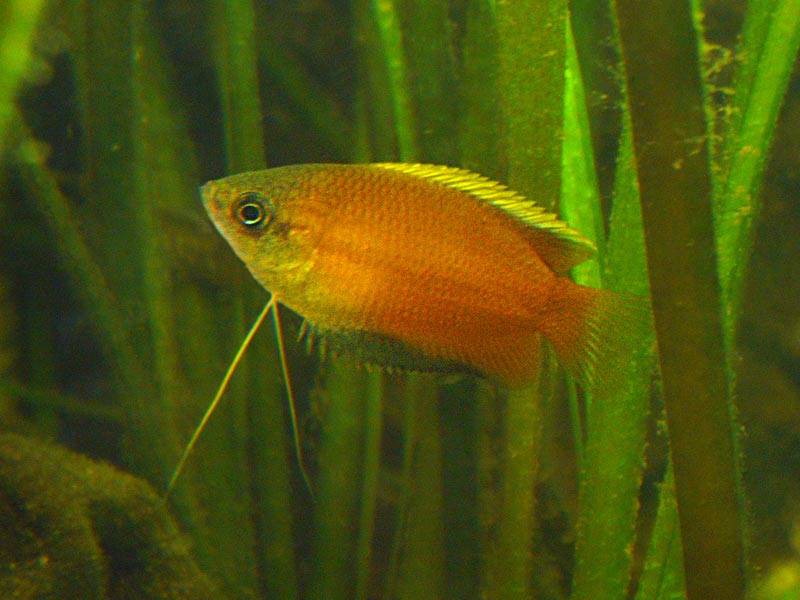
Honey gourami
Small orange freshwater fish from India and Bangladesh
The honey gourami is a small, peaceful freshwater fish native to rivers and lakes in India and Bangladesh. It features bright orange colouring and bubble-nest breeding behaviour, making it a popular choice for community aquaria.
- Reaches a maximum length of 5.5 cm
- Males build bubble nests for breeding
- Native to rivers and lakes in India
- Prefers soft and poorly mineralised water
- Male throat turns bright orange when breeding
What it is
The honey gourami is a small species of fish belonging to the gourami group. Adults reach a maximum length of 5.5 centimetres. Their bodies are primarily orange in colour. Males are more vibrant than females, displaying bright orange throats that intensify during breeding. The male underside turns black when ready to spawn, and their fins develop an orange tinge, except for the tail. Males also possess longer fins, including a pointed dorsal fin and extended anal rays.
Where it lives
This species is native to the countries of India and Bangladesh. It inhabits freshwater environments such as rivers and lakes. The fish prefers areas with dense vegetation and water that is soft and poorly mineralised. In these habitats, honey gouramis typically occupy the upper and middle levels of the water column, seeking shelter among plants.
How it lives
Honey gouramis are generally timid and prefer sheltered environments with plenty of cover. In the wild, they stay near thick vegetation. They are tolerant of various water conditions but thrive best between 22 and 28 degrees Celsius. While peaceful, males can show territorial aggression towards each other in confined spaces. In larger tanks with structure, they establish separate territories and coexist better. They are best kept with small, non-aggressive tankmates.
Breeding and life cycle
Reproduction involves bubble-nest spawning, a trait common in anabantoid fishes. The male builds a floating nest using air bubbles and plant material. During courtship, his colours brighten significantly. He embraces the female under the nest to release and fertilise eggs. The male collects the sinking eggs and places them in the nest. He alone guards and maintains the nest while the female leaves. Eggs hatch in about two days, and larvae become free-swimming shortly after.
Fish and people
This fish is widely kept in small freshwater aquaria due to its peaceful nature. It suits modest-sized tanks if provided with dense vegetation and structural cover to reduce stress. Hobbyists avoid aggressive or active tankmates, preferring species like tetras, barbs, corydoras, and platys. The honey gourami is valued for its calm behaviour and attractive appearance, though males may need space to prevent conflict.
Questions people ask about Honey gourami
How big do honey gouramis get?
Adult honey gouramis are small fish that reach a maximum total length of 5.5 centimetres. This compact size makes them suitable for modest-sized freshwater aquaria.
Are honey gouramis aggressive?
They are generally peaceful community fish. However, males may display territorial aggression toward one another in confined conditions. Providing a larger tank with structure helps them coexist.
How do honey gouramis breed?
Males construct floating bubble nests using air and plant material. After spawning, the male collects the eggs into the nest and guards them alone until they hatch in about two days.
Good reading and sources
- Honey gourami on WikipediaEncyclopedia
- More photos on Wikimedia CommonsPhotos
- Wikidata recordOpen data
The facts on this page come from the Wikipedia article "Honey gourami", written by its contributors and used under the CC BY-SA 4.0 licence, and from its Wikidata record (CC0). EveryFish rewrote the text in its own words, with AI assistance, and compares every page with the article to make sure no passage is copied. It may be reused under the same CC BY-SA 4.0 licence with a link back.
It may contain mistakes, and figures change over time. Nothing here is investment or buying advice. If something is wrong, tell us. Last refreshed 2026-11-15.
Like Honey gourami
All other fish Southeast AsiaKissing gourami
A Southeast Asian freshwater fish known for its unique mouth-to-mouth sparring behaviour.Other · Rivers and lakes
 Southeast AsiaBumblebee goby
Small striped freshwater and brackish gobies from AsiaOther · Rivers and lakes
 WorldWeather loach
Small freshwater fish active before stormsOther · Rivers and lakes
 WorldSilver dollar
Round, silver tropical fish related to piranhas, popular in aquariums.Other · Rivers and lakes