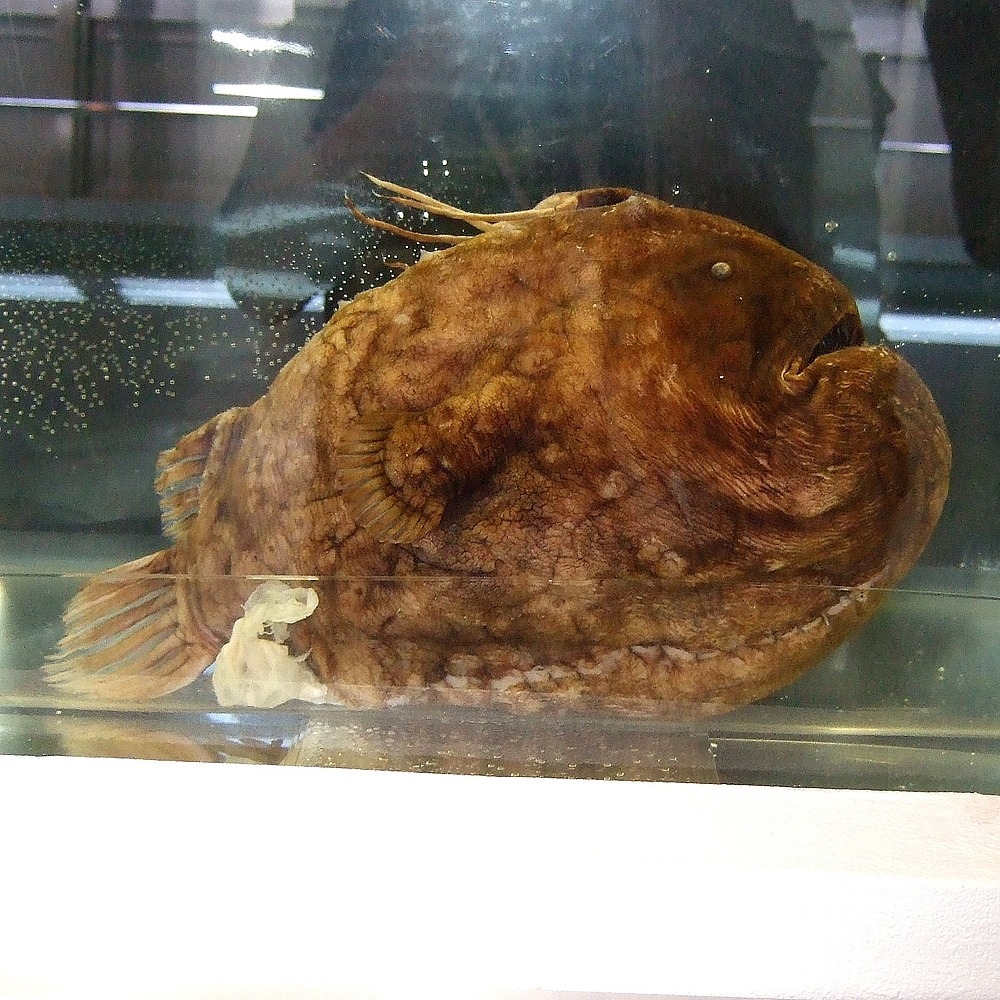
Atlantic footballfish
Deep-sea anglerfish with a glowing lure
The Atlantic footballfish is a deep-sea anglerfish found in tropical and temperate oceans. Females use a bioluminescent lure to catch prey in dark waters, while tiny males attach temporarily for mating.
- Females grow to 60 cm while males reach only 4 cm
- Uses bioluminescent bacteria in its lure to attract prey
- Males attach temporarily to females but do not fuse
- Found in Atlantic, Indian, and Pacific Ocean depths
- First described by Johan Reinhardt in 1837
What it is
This marine ray-finned fish belongs to the footballfish family. It shows extreme differences between sexes. Females grow up to 60 cm with a prominent lure, while males reach only 4 cm. The female has a thick, leathery illicium topped with a glowing esca. Her skin bears scattered conical spines and rounded papillae on the chin. Males possess large olfactory organs and sideways-pointing nostrils to detect mates. Both sexes have specialized denticular bones formed from merged teeth.
Where it lives
The species inhabits the Atlantic Ocean, ranging from Greenland and Iceland south to South Africa. Records suggest it may also live in the Western Indian Ocean and Western Pacific. A related group member appears off northern Chile. These fish dwell in the mesopelagic and bathypelagic zones. They typically swim at depths between 200 and 800 metres. This environment is characterised by darkness and sparse food resources.
How it lives
Females hunt in the dark using bioluminescent bacteria within their esca. This light attracts prey such as fish, squid, and crustaceans. Backward-curving teeth prevent captured animals from escaping. Males live freely and do not parasitise females. They rely on highly developed smell to locate partners. Once found, a male attaches temporarily using specialized teeth. Scars on some females indicate males can detach later. Sperm whales in the Azores have been known to eat them.
Breeding and life cycle
Males are much smaller than females and remain free-living. They use their sense of smell to find a mate. Upon contact, the male attaches to the female but does not fuse with her tissue. Specialized teeth on his denticular bones secure this temporary bond. The eggs and larvae drift in the open ocean as pelagic forms. This strategy allows reproduction in vast, dark waters where encounters are rare.
Fish and people
There is no significant commercial fishing or aquarium trade for this deep-sea species. It occasionally appears in scientific studies due to its unique biology. Specimens sometimes wash ashore or are caught incidentally. Its presence in sperm whale stomachs provides data on deep-ocean food webs. The name derives from Greek words for leather strap and crest, referring to its lure.
Status and threats
Conservation status is not assessed in the provided material. The species lives in remote deep-sea environments. Threats from direct fishing are likely low due to its habitat. However, deep-sea ecosystems face risks from climate change and pollution. More research is needed to understand population trends. Its wide distribution across multiple oceans may offer some resilience.
Questions people ask about Atlantic footballfish
How big does the Atlantic footballfish get?
Females can grow up to 60 cm in length, while males are significantly smaller, reaching a maximum of only 4 cm. This extreme size difference is a key feature of the species.
Does the male attach permanently to the female?
No, the male attaches temporarily using specialized teeth. Unlike some other anglerfish, he does not fuse with the female's tissue and can detach, sometimes leaving scars.
Where does this fish live?
It lives in the mesopelagic and bathypelagic zones of the ocean, typically at depths between 200 and 800 metres. It is found primarily in the Atlantic but may range into other oceans.
What does the Atlantic footballfish eat?
The female uses a glowing lure to attract prey in the dark. She eats whatever fits into her mouth, including other fishes, squid, and crustaceans, which cannot escape her backward-curving teeth.
Good reading and sources
- Himantolophus groenlandicus on WikipediaEncyclopedia
- More photos on Wikimedia CommonsPhotos
- Wikidata recordOpen data
The facts on this page come from the Wikipedia article "Himantolophus groenlandicus", written by its contributors and used under the CC BY-SA 4.0 licence, and from its Wikidata record (CC0). EveryFish rewrote the text in its own words, with AI assistance, and compares every page with the article to make sure no passage is copied. It may be reused under the same CC BY-SA 4.0 licence with a link back.
It may contain mistakes, and figures change over time. Nothing here is investment or buying advice. If something is wrong, tell us. Last refreshed 2026-11-15.
Like Atlantic footballfish
All other fish WorldCommon fangtooth
A small, black deep-sea fish with large fangs found worldwide.Other · Open ocean · 1833
 WorldAnglerfish
Ray-finned fish using a modified dorsal fin ray as a lure to catch prey.Other · Coasts and shelves · 1829
 WorldSnailfish
A family of marine ray-finned fishes found from shallow coasts to the deepest ocean trenches.Other · Coasts and shelves · 1861
 WorldHumpback anglerfish
Deep-sea black seadevil with a glowing lureOther · Open ocean · 1863