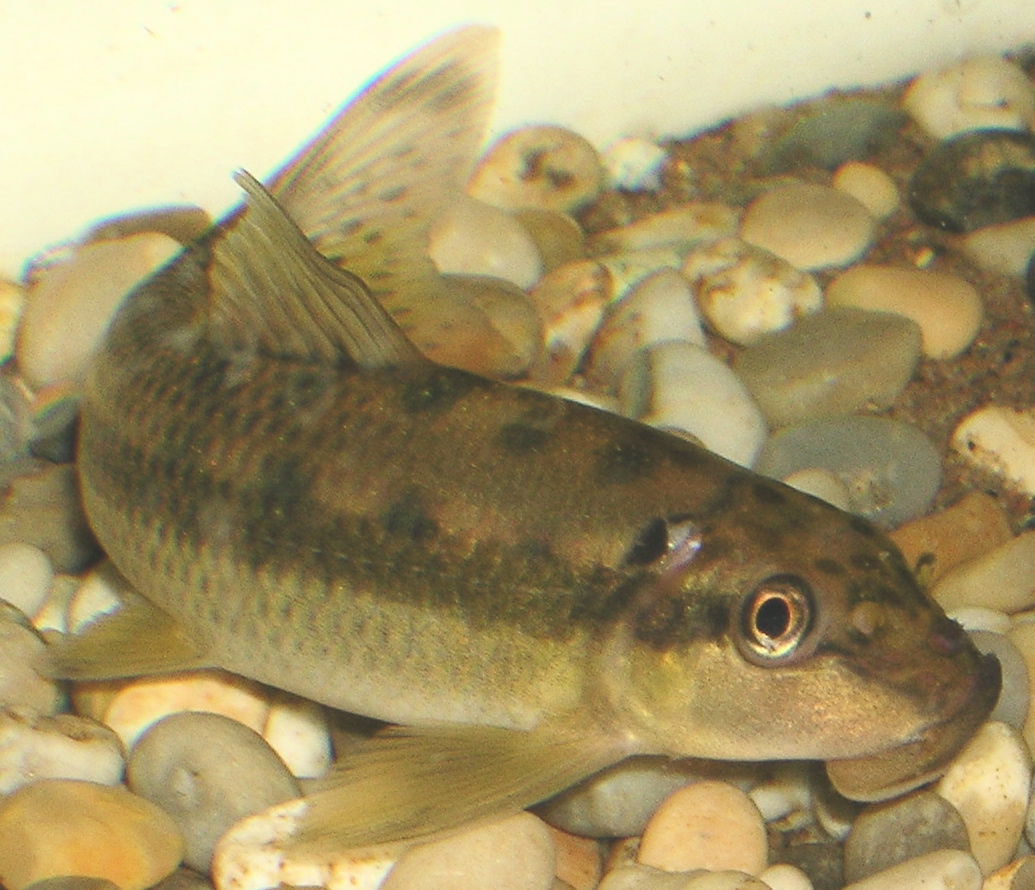
Gyrinocheilus aymonieri
A Southeast Asian freshwater fish known for its suction-like mouth and role in the aquarium trade.
This species inhabits major river systems across Southeast Asia, including the Mekong and Chao Phraya basins. It is widely traded globally as an aquarium cleaner and consumed locally in traditional dishes like prahok.
- Mouth acts as a sucker to attach to rocks in fast-flowing water.
- Reaches a maximum recorded size of 28 cm standard length.
- Used locally to make prahok, a traditional fermented fish paste.
- Commonly sold in the aquarium trade as an algae cleaner.
- Found in major basins including the Mekong and Chao Phraya.
What it is
The honey sucker is a freshwater fish native to large parts of Southeast Asia. It reaches at least 28 cm in standard length. The body ranges from pale grey to olive, often featuring darker markings along the lateral line or belly. A key feature is its inferior mouth, modified into a sucker that allows attachment to smooth surfaces like rocks in strong currents. Unlike many similar fish, it lacks barbels. It is the only species in its genus with nine branched dorsal rays and between thirty-six and forty lateral line scales.
Where it lives
Populations exist in the Chao Phraya basin, northern Malay Peninsula, Mae Klong basin, and the Xe Bang Fai River. The Mekong basin holds significant numbers across Cambodia, Yunnan province in China, Laos, Thailand, and Vietnam. These fish prefer large rivers with flowing water but occasionally enter flooded agricultural fields. They spend most of their time adhering to flat surfaces such as rocks within these dynamic aquatic environments.
How it lives
Wild types display variable colouration, typically paler bellies and varying dark patterns along the back or caudal fin, though pelvic and anal fins remain unmarked. In home aquaria, colour morphs include gold, marble, albino, and leucistic forms. Fish are frequently purchased for their ability to consume algae readily. They are sometimes confused with other aquarium species like Crossocheilus oblongus or Epalzeorhynchos kalopterus due to similar appearances.
Breeding and life cycle
Reproduction is rarely observed in captive settings. Occasional reports mention fry appearing in heavily planted tanks, but specific spawning triggers remain unknown. Distinguishing sexes is challenging, though mature males might develop breeding tubercles on their noses while females tend to appear plumper. No definitive methods for inducing reproduction have been established by hobbyists.
Fish and people
Local markets sell this fish as a food source. Small individuals are specifically used in the preparation of prahok, a traditional fermented fish paste. Beyond consumption, the species holds substantial importance in the global aquarium trade. Hobbyists value them for cleaning algae from tanks. Other genus members like Gyrinocheilus pennocki and Gyrinocheilus pustulosus are seldom seen in this commercial context compared to G. aymonieri.
Status and threats
No specific conservation threats or protection measures are detailed in the provided material. The species appears stable within its native range across multiple countries. Its widespread presence in major river basins suggests a resilient population status. However, habitat alterations in rapidly developing regions could potentially impact local populations over time.

Questions people ask about Gyrinocheilus aymonieri
What is the primary function of the honey sucker's mouth?
The mouth is inferior and modified into a sucker. This adaptation allows the fish to attach itself firmly to smooth surfaces like rocks, enabling it to withstand strong water currents in its natural river habitat.
How can you distinguish this species from similar aquarium fish?
It is the only species in its genus possessing nine branched dorsal rays and between thirty-six and forty lateral line scales. Visual confusion often occurs with Crossocheilus oblongus or Epalzeorhynchos kalopterus due to similar colouration.
Is this fish commonly bred in home aquariums?
No, it does not breed readily in captivity. While occasional fry are found in overgrown tanks, no definitive spawning triggers are currently known to hobbyists or researchers.
Where is this fish native to?
It is native to large parts of Southeast Asia. Key habitats include the Chao Phraya basin, northern Malay Peninsula, Mae Klong basin, Xe Bang Fai River, and various locations within the Mekong basin across several countries.
Good reading and sources
- Gyrinocheilus aymonieri on WikipediaEncyclopedia
- More photos on Wikimedia CommonsPhotos
- Wikidata recordOpen data
The facts on this page come from the Wikipedia article "Gyrinocheilus aymonieri", written by its contributors and used under the CC BY-SA 4.0 licence, and from its Wikidata record (CC0). EveryFish rewrote the text in its own words, with AI assistance, and compares every page with the article to make sure no passage is copied. It may be reused under the same CC BY-SA 4.0 licence with a link back.
It may contain mistakes, and figures change over time. Nothing here is investment or buying advice. If something is wrong, tell us. Last refreshed 2026-11-15.
Like Gyrinocheilus aymonieri
All other fish 🇧🇷 Brazil and 1 moreRed-bellied Pacu
A large South American freshwater fish related to piranhas, farmed for food and kept in aquariums.Other · Rivers and lakes
 Southeast AsiaGiant snakehead
A large freshwater predator from Southeast Asia known for air breathing and invasive potential.Other · Rivers and lakes
 🇧🇷 BrazilBanded leporinus
A striped freshwater fish from the Amazon kept in home tanks and occasionally caught by anglers.Other · Rivers and lakes
 🇧🇼 Botswana and 1 moreAfrican tigerfish
Predatory freshwater fish known for sharp teeth and leaping hunting behaviour.Other · Rivers and lakes · 1861