
Crocodile shark
Smallest living mackerel shark with large eyes and oily liver
The crocodile shark is a small, deep-water predator found in tropical oceans worldwide. It migrates vertically each day, hunting squid and fish at night while resting in deeper waters by day. Its unique biology includes an oily liver for buoyancy and embryos that eat unfertilised eggs.
- Smallest living mackerel shark at just over one metre
- Migrates vertically daily to feed in shallower waters at night
- Embryos feed on unfertilised eggs provided by the mother
- Damaged early deep-sea fiberoptic cables in 1985
- Large oily liver helps maintain buoyancy with minimal effort
What it is
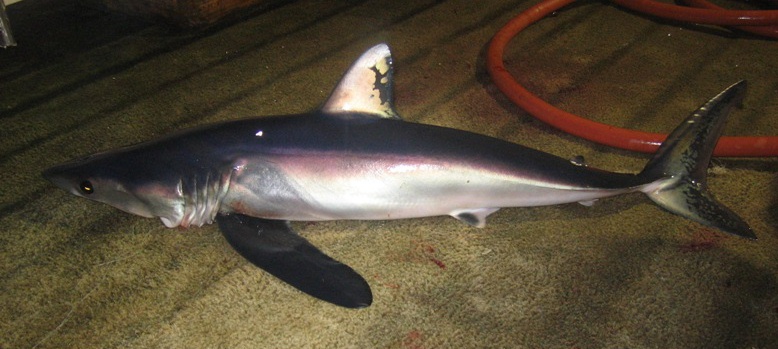
This species is the sole surviving member of its family and the smallest extant mackerel shark. It has a spindle-shaped body with a short head and pointed snout. The eyes are exceptionally large and lack protective third eyelids. Five long gill slits extend onto the upper surface. Its jaws protrude significantly, holding spike-like front teeth and knife-edged side teeth. Small, rounded pectoral fins balance larger pelvic fins. The first dorsal fin is low and angular, while the second is smaller than the first but larger than the anal fin. The tail fin is asymmetrical with a longer upper lobe. Colouration is dark brown above and paler below, often with white fin margins.
Where it lives
The distribution is almost circumtropical, bounded by average sea surface temperatures of 20 °C. In the Atlantic, it occurs off Brazil, West Africa and South Africa, but not the northwest. Indian Ocean records include the Mozambique Channel and Bay of Bengal. Pacific populations range from Japan and Taiwan to New Zealand and the Americas, including many island groups. It inhabits the pelagic zone from the surface to 590 metres. While usually oceanic, it occasionally strands on beaches, possibly due to cold water upwellings. A specimen washed ashore in England in 2017, far north of its typical range.
How it lives
It performs diel vertical migration, staying below 200 metres during daylight and rising to feed at night. A large liver rich in low-density lipids provides neutral buoyancy, reducing swimming effort. Large eyes with reflective retinas suggest it hunts by sight in low light, targeting silhouettes or bioluminescence. Diet comprises small bony fishes like lanternfish, various squid species and shrimp. Strong musculature indicates active, fast swimming. No natural predators are known. It is locally abundant in certain areas rather than evenly spread, implying limited long-distance migration.
Breeding and life cycle
Reproduction is aplacental viviparous, with females typically bearing four pups, two per uterus. Embryos initially rely on yolk sacs. Once absorbed, they become oophagous, consuming thin-walled egg capsules produced by the mother. This ingested material can constitute a quarter of the embryo weight. It remains unclear how multiple fetuses survive in one uterus, unlike in some related sharks where only one persists. Pups are born at roughly 40 cm. Males mature between 74 and 110 cm, females between 89 and 102 cm. There is no defined breeding season.
Fish and people
Due to its small size and oceanic habitat, it poses little threat to humans, though its bite is powerful. It is frequently caught as bycatch in tuna and swordfish longline fisheries, particularly in the Indian Ocean. Most catches are discarded because the meat is of low quality, although the oily liver has potential value. In 1985, this species damaged early deep-sea fiberoptic cables, likely attracted by electric fields during deployment. Steel tape protection resolved the issue. It holds no major cultural significance but is noted for its unique biological traits.
Status and threats
The International Union for Conservation of Nature lists it as Near Threatened. Population data is scarce, but numbers are likely declining due to bycatch mortality in commercial fisheries. Its low reproductive rate exacerbates this vulnerability. In New Zealand, it is classified as Data Deficient with a Secure Overseas qualifier. Fossil teeth from the Miocene epoch found in Italy are identical to modern specimens, indicating long-term morphological stability. Continued monitoring is needed to assess the impact of fishing pressure.


Questions people ask about Crocodile shark
Is the crocodile shark dangerous to humans?
No, it is not considered dangerous due to its small size and oceanic habitat. However, it has a powerful bite and should be handled with caution if caught. It lives in deep water and rarely interacts with people.
Why did crocodile sharks attack undersea cables?
In 1985, they bit fiberoptic cables during deployment, likely attracted by the electric fields. They are not bottom-dwellers, so the attacks occurred while the cables were being laid. Steel tape protection solved the problem.
What does the crocodile shark eat?
It feeds on small to medium-sized bony fishes such as bristlemouths and lanternfishes. Its diet also includes various types of squid and shrimp. It hunts at night using its large eyes to detect prey.
How do crocodile shark embryos develop?
They are oophagous, meaning unborn pups feed on unfertilised eggs produced by the mother. This occurs after the initial yolk sac is absorbed. Typically, four pups are born per litter.
Good reading and sources
- Crocodile shark on WikipediaEncyclopedia
- More photos on Wikimedia CommonsPhotos
- Wikidata recordOpen data
The facts on this page come from the Wikipedia article "Crocodile shark", written by its contributors and used under the CC BY-SA 4.0 licence, and from its Wikidata record (CC0). EveryFish rewrote the text in its own words, with AI assistance, and compares every page with the article to make sure no passage is copied. It may be reused under the same CC BY-SA 4.0 licence with a link back.
It may contain mistakes, and figures change over time. Nothing here is investment or buying advice. If something is wrong, tell us. Last refreshed 2026-11-15.
Like Crocodile shark
All sharks WorldTiger shark
A large predatory shark known for its striped pattern and diverse diet.Shark · Coasts and shelves · 1822
 WorldBlue shark
A slender, deep-blue oceanic shark found in temperate and tropical seas worldwide.Shark · Open ocean
 WorldPacific sleeper shark
Large deep-sea shark of the North PacificShark · Open ocean
 WorldLongfin mako shark
A rare, deep-water mackerel shark with long pectoral finsShark · Open ocean · 1966