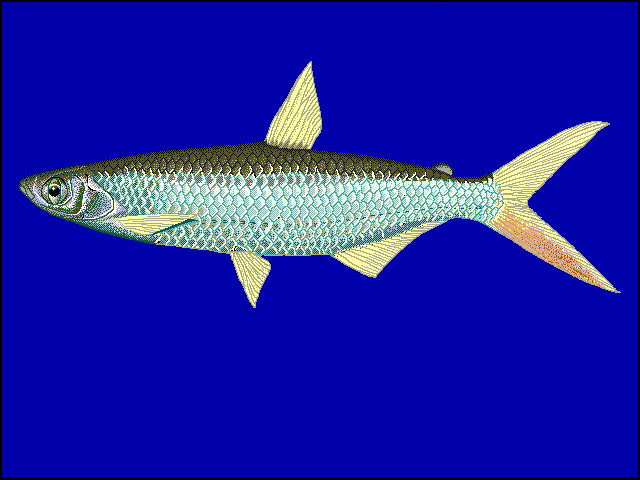
Pebbly fish
A silver characin from African rivers and lakes.
The pebbly fish is a freshwater characin found across northern and western Africa. It supports local fisheries as a valued food source, particularly in the Nile basin and Lake Chad regions.
- Grows up to 43 cm in length.
- Diet shifts from plankton to plants.
- Spawns in late afternoon batches.
- Valued food fish in Uganda and Sudan.
- Range reduced in Egypt by dams.
What it is
This species is a silver-coloured characin with a bluish-grey back and white belly. Its fins appear greyish, while the lower lobe of the tail fin shows an orange hue. Adults grow up to 43 cm long and weigh around 500 g. Sexual maturity occurs when the fish reaches approximately 20 cm in length. It belongs to the family Alestidae within the order Characiformes.
Where it lives
The fish inhabits freshwater systems in northern and western Africa. In the east, it lives in Lake Albert, Lake Turkana, and the White Nile. Construction of the Aswan High Dam restricted its range in Egypt to the upper Nile, removing it from the delta. It occurs in Sudanese waters like the Blue Nile and Lake Nasser, and in Ethiopia’s Baro River. West African populations thrive in the basins of the Niger, Volta, Senegal, and Lake Chad.
How it lives
Active during the day, this fish stays near shorelines in lakes. It displays potamodromous behaviour, migrating upriver during floods. Non-breeding adults form shoals in these flooded rivers to feed. The diet is flexible, shifting from zooplankton to bottom-dwelling creatures, detritus, and plant matter depending on availability. This generalist feeding strategy helps it adapt to changing food densities in its environment.
Breeding and life cycle
Spawning activity takes place in sheltered bays along lake shores. In Lake Chad, females release eggs in a single batch during the late afternoon and evening hours. These eggs account for about 15 per cent of the female’s body weight. Mature females disperse individually during this process rather than forming groups. This timing and behaviour ensure the next generation has a start in protected waters.
Fish and people
Known as Angara in Uganda, this fish is a valuable commercial product in East and Central Africa. Consumers in the West Nile region prize its taste and texture. Salting preserves the catch and creates products that meet market demand. Nutritional analysis shows crude protein levels between 17 and 18 per cent. Zinc is the most abundant micro-element, while potassium dominates among macro-minerals. Fisheries use seine and gill nets to harvest it.
Questions people ask about Pebbly fish
What does the pebbly fish eat?
It is an omnivore with a flexible diet. It consumes zooplankton, bottom-dwelling animals, detritus, and aquatic plants. The specific food source depends on what is most available in its environment at the time.
Where is this fish found?
It lives in freshwater systems across northern and western Africa. Key locations include the Nile basin, Lake Chad, and river basins such as the Niger, Volta, and Senegal. It prefers inshore zones of lakes and rivers.
Is the pebbly fish good to eat?
Yes, it is a highly marketable food fish in regions like Uganda and Sudan. People value its special flavour and texture. It is often salted to extend shelf life and contains significant protein and minerals.
Good reading and sources
- Alestes baremoze on WikipediaEncyclopedia
- More photos on Wikimedia CommonsPhotos
- Wikidata recordOpen data
The facts on this page come from the Wikipedia article "Alestes baremoze", written by its contributors and used under the CC BY-SA 4.0 licence, and from its Wikidata record (CC0). EveryFish rewrote the text in its own words, with AI assistance, and compares every page with the article to make sure no passage is copied. It may be reused under the same CC BY-SA 4.0 licence with a link back.
It may contain mistakes, and figures change over time. Nothing here is investment or buying advice. If something is wrong, tell us. Last refreshed 2026-11-15.
Like Pebbly fish
All other fish Southeast AsiaKissing gourami
A Southeast Asian freshwater fish known for its unique mouth-to-mouth sparring behaviour.Other · Rivers and lakes
 WorldNile perch
Large freshwater predator native to Africa, now invasive in many lakes.Other · Rivers and lakes
 WorldWeather loach
Small freshwater fish active before stormsOther · Rivers and lakes
 🇧🇷 Brazil and 4 moreGolden dorado
A large predatory freshwater fish native to South America known for its golden colour.Other · Rivers and lakes
More from Alestidae
All of them 🇺🇬 UgandaNangnang fish
A small freshwater fish from the Nile basin, prized as a fried snack in Uganda.Other · Rivers and lakes
 WorldTetra
Common name for small freshwater characiform fishes popular in aquaria.Livebearer · Rivers and lakes
 🇧🇼 Botswana and 1 moreAfrican tigerfish
Predatory freshwater fish known for sharp teeth and leaping hunting behaviour.Other · Rivers and lakes · 1861
 🇨🇩 Democratic Republic of the CongoCongo tetra
A colourful African freshwater fish kept in home aquaria for its bright scales and feathery tail.Other · Rivers and lakes · 1899