
Ribbonfish
Deep-sea lampriforms with long, tape-like bodies
Ribbonfish are pelagic lampriforms in the family Trachipteridae, known for their slender, ribbon-shaped bodies and deep-water habitat. About ten species exist, rarely seen alive due to their depth, though some wash ashore after storms or appear in cultural folklore.
- Body shape is long, compressed, and tape-like
- Dorsal fin extends along the entire back
- Fins are delicate, brittle, and adapted for depth
- Called earthquake fish in Taiwan due to folklore
- Often wash ashore after winter gales
What it is
Ribbonfish belong to the family Trachipteridae within the order Lampriformes. They possess a distinctively long, compressed body that resembles a tape or ribbon. Their heads are short with narrow mouths and weak teeth. A high dorsal fin runs the entire length of the back, while the anal fin is missing. The tail fin, when present, features two bundles of rays, with the upper set extending upward. Pectoral fins are small, and pelvic fins may have several rays or just one long one. Heavy spines line their lateral lines, and their skin contains numerous lumps. Their fins and connecting membranes are delicate and brittle, typical of deep-sea dwellers.
Where it lives
These fish inhabit pelagic zones in the Atlantic, Mediterranean, Bay of Bengal, Mauritius, and the Pacific. In the north Atlantic, they are found near Iceland, Scandinavia, Orkney, and Scotland. They typically live in deep waters but are not bottom feeders. Specimens often wash ashore during winter gales, left by the tide. One living specimen was observed in shallow water in Scandinavia, moving obliquely like a flatfish. Another injured individual was found on a beach in Kenting, Taiwan, and returned to deeper water.
How it lives
Ribbonfish are pelagic creatures that reside in deep ocean waters. They are rarely observed alive because of their habitat depth. Their anatomy suggests adaptation to high-pressure environments, with fragile fin structures. Young individuals may exhibit extraordinarily prolonged fin rays, sometimes with appendages. They do not feed on the sea floor. Sightings often occur when storms drive them toward the shore. Their movement in shallow water has been described as similar to that of a flatfish, with one side turned upwards.
Fish and people
In Taiwan, the species Trachipterus ishikawae is known as the earthquake fish. Local belief holds that these fish appear after major seismic events due to sensitivity to ocean floor disturbances. Records note appearances after earthquakes in Hengchun and Taitung, as well as sightings in Japan in March 2011. However, not all sightings correlate with seismic activity. In northern Europe, the north Atlantic species is called deal fish in English, vogmær in Icelandic, and vågmär in Swedish.
Questions people ask about Ribbonfish
Why are they called earthquake fish?
In Taiwan, Trachipterus ishikawae is believed to appear after major earthquakes due to alleged sensitivity to ocean floor disturbances. Sightings were recorded after events in Hengchun, Taitung, and Japan, though not all appearances match seismic data.
How large do ribbonfish grow?
The north Atlantic species usually measures between 1.5 and 3.5 metres in length. Some specimens have been found exceeding 6 metres. They are among the longer bony fish, with a slender, ribbon-like form.
Are ribbonfish related to red bandfish?
No. Although the red bandfish is sometimes called ribbonfish, it is a perciform fish and is unrelated to the Trachipteridae family. True ribbonfish are lampriforms with distinct anatomical features like a full-length dorsal fin.
Good reading and sources
The facts on this page come from the Wikipedia article "Ribbonfish", written by its contributors and used under the CC BY-SA 4.0 licence, and from its Wikidata record (CC0). EveryFish rewrote the text in its own words, with AI assistance, and compares every page with the article to make sure no passage is copied. It may be reused under the same CC BY-SA 4.0 licence with a link back.
It may contain mistakes, and figures change over time. Nothing here is investment or buying advice. If something is wrong, tell us. Last refreshed 2026-11-15.
Like Ribbonfish
All other fish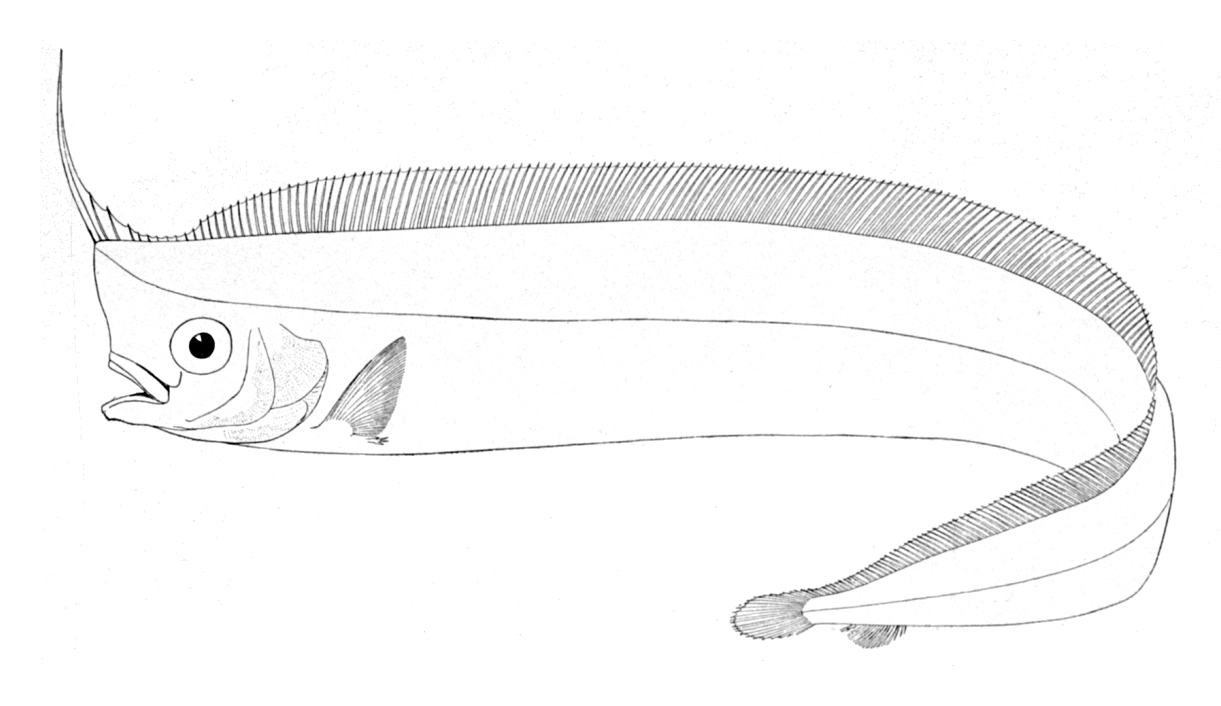 WorldCrestfish
Deep-sea ribbon fish with a head crest and ink sacsOther · Open ocean
 WorldGlasshead barreleye
Deep-sea fish with mirror-based eyesOther · Open ocean
 WorldMarine hatchetfish
Small deep-sea fish with a distinctive compressed body shape and bioluminescent camouflage.Other · Open ocean
 WorldBarreleye
Deep-sea fish with tubular eyes and a light-producing anusOther · Open ocean