
Gilt-head bream
A prized Mediterranean food fish with a golden head band.
The gilt-head bream is a marine fish found in the Eastern Atlantic and Mediterranean. It is highly valued for its mild flesh and is a major species in aquaculture, particularly in Turkey and Greece. This fish changes sex from male to female as it matures.
- Named for the golden bar between its eyes.
- Changes sex from male to female as it ages.
- Major aquaculture species in Turkey and Greece.
- Feeds mainly on shellfish using strong teeth.
- Wild catches are far lower than farmed production.
What it is
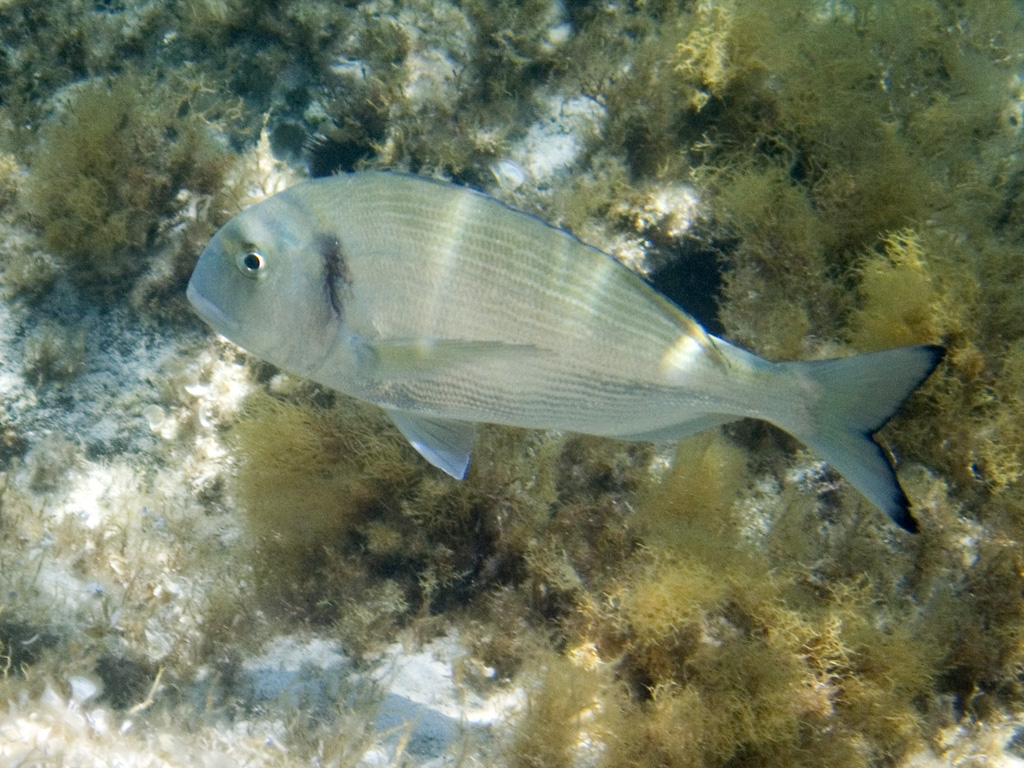
This marine ray-finned fish belongs to the seabream family. It has a deep body and a large head with small, high-set eyes. A distinctive golden bar runs across the head between the eyes, giving it its name. The back is blue-grey, while the sides are silvery with a dark spot behind the eye. The operculum margin is red. Adults typically reach 35 cm, though they can grow to 70 cm and weigh over 17 kg. It possesses robust teeth, including canine-like front teeth for crushing shells.
Where it lives
The species inhabits the northeastern Atlantic Ocean and the Mediterranean Sea. Its range extends from Great Britain and Ireland south to Senegal, including the Canary Islands. It is also present in the southern and western Black Sea. Populations around Madeira are likely escapes from fish farms. These fish live over sandy bottoms and in seagrass beds. They are euryhaline, meaning they can tolerate varying salt levels and enter brackish waters. Juveniles stay in shallow water up to 30 m deep, while adults dwell deeper, down to 150 m.
How it lives
Gilt-head bream feed primarily on shellfish, using their strong jaws to crush them. They also consume some plant matter. A key biological trait is their reproductive strategy. They are protandrous sequential hermaphrodites. This means they all mature as males by the age of two. Later in life, some individuals develop ovaries and lose their testes, becoming females. This shift allows for flexible population dynamics. Their genome shows fast evolution in genes related to ovary development, linked to this unique mode of reproduction.
Breeding and life cycle
Spawning details such as specific seasons or egg counts are not detailed in the provided text, but the sexual development is well documented. All fish start life as males. At around two years old, they become sexually mature males. As they age, a portion of the population transitions into females. This change involves the development of ovarian tissue and the regression of testicular tissue. This biological mechanism is reflected in their genetic makeup, which shows rapid changes in ovary-biased genes.
Fish and people
This fish is highly esteemed for its culinary value, especially in Southern Europe. The flesh is mild, sweet, and breaks into small flakes. While wild catches are modest, averaging under 10,000 tons annually, aquaculture production is massive. Intensive rearing systems developed in the 1980s boosted output to 140,000 tons by 2010. Turkey and Greece are the leading producers. Farming challenges include skeletal abnormalities from high stocking density and parasitic or bacterial infections. It remains a staple of Mediterranean seafood traditions.


Questions people ask about Gilt-head bream
Why is it called gilt-head bream?
The name comes from the distinctive golden bar located on the head between the eyes. The scientific name aurata also means gold, referring to this specific marking.
Is this fish wild-caught or farmed?
Both, but farming dominates. Wild catches are modest, while aquaculture production reached 140,000 tons in 2010. Turkey and Greece are the largest producers of farmed gilt-head bream.
Do gilt-head bream change sex?
Yes, they are protandrous hermaphrodites. They all mature as males at age two. Later in life, some individuals transition into females by developing ovaries and losing their testes.
What does gilt-head bream taste like?
It is highly regarded for its mild and sweet flavour. The flesh is popular in Southern Europe because it breaks into small, delicate flakes when cooked.
Good reading and sources
- Gilt-head bream on WikipediaEncyclopedia
- More photos on Wikimedia CommonsPhotos
- Wikidata recordOpen data
The facts on this page come from the Wikipedia article "Gilt-head bream", written by its contributors and used under the CC BY-SA 4.0 licence, and from its Wikidata record (CC0). EveryFish rewrote the text in its own words, with AI assistance, and compares every page with the article to make sure no passage is copied. It may be reused under the same CC BY-SA 4.0 licence with a link back.
It may contain mistakes, and figures change over time. Nothing here is investment or buying advice. If something is wrong, tell us. Last refreshed 2026-11-15.
Like Gilt-head bream
All perches, basses and snappers WorldMangrove red snapper
Large Indo-Pacific snapper found in mangroves and reefsPerch-like · Rivers and lakes · 1775
 WorldMalabar grouper
Large Indo-Pacific reef fish with dark spotsPerch-like · Coasts and shelves
 🇪🇸 Spain and 1 moreCommon dentex
Large-toothed seabream of the Atlantic and Mediterranean.Perch-like · Coasts and shelves · 1758
 WorldRed porgy
A pink-hued seabream found in warm Atlantic coastal waters.Perch-like · Coasts and shelves · 1758

